Deepfakes, how to spot an AI-generated voice or face
Listen to the audio version
The article on the Aura breach showed that a simple, convincing human voice on the phone is already enough to deceive someone. A deepfake pushes that same logic one step further: it's no longer a person imitating a voice or a face, it's an artificial intelligence generating a copy realistic enough to fool someone in real time.
What a deepfake actually is, technically
A deepfake is audio or video content generated or altered by artificial intelligence to imitate a real person's appearance or voice, based on genuine samples used to train the model. The amount of raw material needed has dropped sharply in recent years: a few seconds of public audio, an interview, a video posted on social media, can now be enough to train a voice clone convincing enough to fool a relative or coworker on the phone.
The fake-executive scam, deepfake edition
A real case from January 2024 shows just how far this risk can go. An employee in the finance department at Arup, a multinational engineering firm, received an email impersonating the group's UK-based CFO, requesting a confidential transaction. Staying cautious, the employee agreed to join a video call to confirm the request. On that call, he saw and heard several colleagues he recognized, including the CFO himself, discussing the operation naturally. In reality, every participant on that call except the targeted employee was an AI-generated deepfake. Convinced by the simultaneous presence of several familiar faces, the employee authorized 15 transfers totaling about $25.6 million in a single day. None of those funds have been recovered since. The fraud was only discovered when the employee directly contacted the company's real headquarters to follow up on the "confidential operation," which nobody there had ever heard of.
How to spot a deepfake, what still works
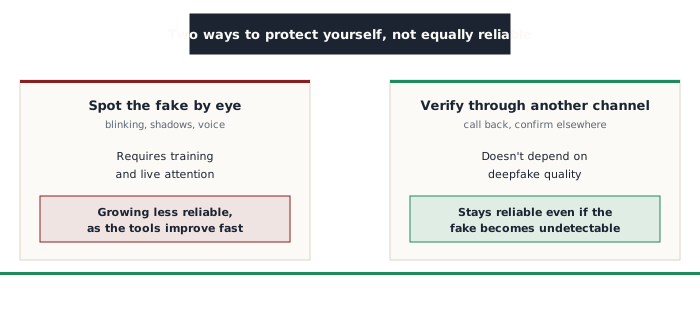
Some signals are still sometimes detectable: blinking that's too regular or absent altogether, shadows or reflections that don't match the room's actual lighting, imperfect syncing between mouth movements and sound, a slightly too-even or robotic tone in a cloned voice, or an oddly delayed reaction to an unexpected question deliberately asked to test the other person.
Why visual detection is becoming less and less reliable
These signals grow rarer and more subtle with every new generation of tools, as the technology keeps improving. Relying only on your own ability to spot a fake by eye or ear amounts to betting on a race where the defending side is structurally falling behind: a signal easy to spot today can vanish completely in the next version of a generation tool, with no amount of personal training keeping pace with that.
The real protection: verification through an independent channel
The lesson that keeps coming back on this site with every new variant of social engineering (see the dedicated article) applies here with even more force: verifying a sensitive request through a channel entirely independent of the one used to contact you stays effective even against a technically undetectable deepfake, since this protection never depends on how good the fake actually is. Calling back a number already known in advance, confirming in person, or simply hanging up and reaching out yourself to the organization or person involved, works exactly the same way as for any other variant of CEO fraud (see the article on phishing), whether it comes through an email, a call, or now an entirely simulated video conference.
A practice increasingly recommended in companies is to set up, in advance, a verbal password (a phrase or code agreed on internally, never mentioned in writing or in public) to be systematically requested for any confirmation of a sensitive operation by phone or video. A deepfake, even a visually flawless one, can't guess a piece of information its model never had the chance to learn.
What this actually changes
For a company, the Arup incident shows that no verification process relying solely on visually or vocally recognizing the other person, even on a video call with several people present, is enough on its own anymore: any request for a transfer or a sensitive change deserves confirmation through a second, entirely independent channel, with no exception based on how many people appear to be on the call. For an individual, the same principle applies to the "relative in distress" scam, a fast-growing variant where a cloned voice of a family member urgently asks for money: hanging up and calling that person directly on their usual number remains, even today, the most reliable check there is.