The Aura breach, the identity-protection company caught out by a single phone call
Listen to the audio version
The article on social engineering mentioned vishing (phishing by phone call) as one of the least flashy variants, but not one of the least effective. A real incident in March 2026 at Aura, a US company specializing in identity protection, offers an almost too-perfect demonstration of it.
What happened
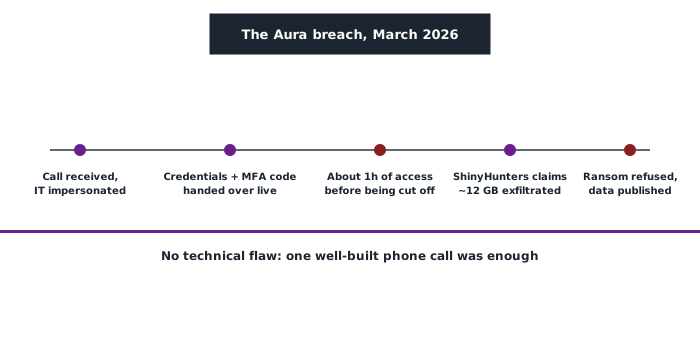
An Aura employee received a phone call from someone impersonating the company's internal IT support. By creating artificial urgency ("your account is being compromised right now, we need to verify your credentials immediately"), the attacker convinced the employee to hand over his single sign-on (SSO) credentials along with a two-factor code generated in real time. The attacker gained access to internal systems for about an hour, before being detected and cut off by Aura's security team. The group ShinyHunters claimed the attack, saying it had exfiltrated about 12 GB of data. Since Aura refused to pay the ransom demanded, the data was then published on the group's leak site, affecting about 900,000 records: names, email addresses, phone numbers, mailing addresses, IP addresses, and customer service comments.
How the attack worked, technically
The sequence matches exactly the vishing pattern described in the article on phishing: impersonating a legitimate internal authority, artificial urgency to prevent any pause for verification, and a request for information meant to stay secret. The most telling detail remains the request for the two-factor code in real time: the attacker didn't just get a password, he asked the employee to read out the code shown on his app or received by SMS at that exact moment during the call, then used that code immediately to authenticate in his place, before it expired.
Why this confirms exactly what the article on two-factor authentication warned about
The article on two-factor authentication described this exact scenario, theoretically, about website phishing: a convincing enough fake site can ask for the password and then the two-factor code, and relay both to the attacker in real time before they expire. The Aura incident shows that this same principle works just as well with no fake site at all, using only a convincing human voice on the phone. What both scenarios have in common stays the same: a one-time code, however well protected technically, remains vulnerable the moment the victim themselves agrees to say it out loud or type it into the wrong site. Only a physical security key (see the article on two-factor authentication again), which cryptographically verifies the service's identity before responding, resists this kind of real-time relay, precisely because no human has any way to "read it aloud" on its behalf.
The irony that got a lot of attention: the protection itself, hit
Part of the media attention around this incident comes from an irony hard to ignore: a company whose entire business is protecting its customers' identity got caught out by one of the oldest, least sophisticated manipulation techniques there is, a simple phone call. This ties directly back to what the article on social engineering explained: this kind of attack doesn't target technical incompetence, but normal human reflexes, and no expertise a company claims to have automatically makes its staff immune to a well-built call, on a day when the targeted person's guard happens to be down.
What this reveals about the data actually stolen
The information exposed in this leak looks more like marketing-list data (names, emails, phone numbers, addresses, customer service comments) than the most sensitive identity data Aura usually monitors for its customers. That doesn't make the leak harmless: 900,000 people ended up with personal contact details exposed publicly, ideal raw material for future targeted phishing attempts (see the article on phishing again) that look more legitimate by citing this real information. But it's worth noting precisely, rather than presenting the leak as worse than it actually was.
What this actually changes
For an organization, this incident is a reminder that a single person can be enough to compromise an entire system, no matter the company's size or claimed expertise, and that verifying a sensitive request must always go through a channel independent of the one used to make contact, exactly the rule already set out in the article on social engineering: call back a known internal number, never the one that called in. For an individual, it remains a reminder that no company, even one specializing in data protection, is immune to a breach, which is a good reason to limit the personal information shared upfront when possible, rather than relying solely on a third party's promise of security.