"Pig butchering," the romance-and-investment scam that has stolen over $75 billion
Listen to the audio version
The article on crypto scams described a guaranteed return as a classic warning sign. Pig butchering combines that same mechanism with something far harder to detect: a human relationship, seemingly real, built over weeks before the first request for money.
What pig butchering is, and where the name comes from
The term comes from the practice of fattening an animal before slaughtering it: the scammer "fattens up" the victim with attention, trust, and a relationship that feels genuine, before the final financial extraction. A recent study estimates worldwide losses from this kind of scam at over $75 billion, with $7.2 billion in losses recorded by the FBI in the US alone in 2025. According to US Federal Trade Commission data, a victim loses an average of $177,000, over a relationship that typically stretches six to twelve months before the final scam.
How the trap unfolds, step by step
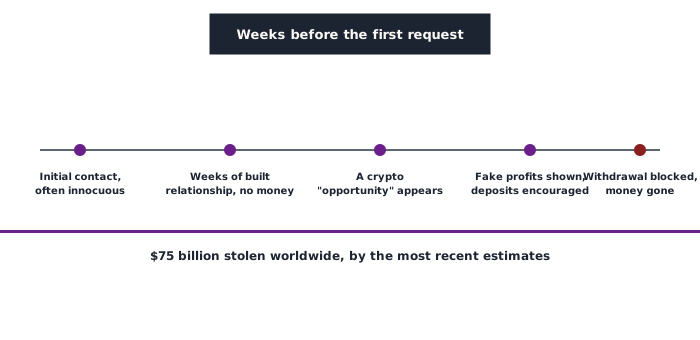
Initial contact often comes through a message seemingly sent to the wrong number, or through a match on a dating app. For several weeks, no request for money comes up at all: a friendly or romantic relationship gradually builds, with sustained attention that makes it feel credible. Only once that trust is firmly in place does the other person bring up a particularly lucrative cryptocurrency investment opportunity, and steer the victim toward a trading platform that looks legitimate. That platform shows profits steadily climbing, sometimes even allowing a first small withdrawal to build confidence further, before a larger withdrawal attempt reveals the money is gone, often accompanied by a request for extra fees or "taxes" supposedly needed to release the funds.
Why it works so well: time as a weapon
The same principle already seen in the article on the Drift Protocol hack (months of built trust before a fast execution) applies here at the scale of an individual rather than an entire financial protocol. The scammer's patience turns a reasonable initial wariness into genuine trust, exactly the mechanism already described in the article on social engineering: the more real and established over time a relationship feels, the psychologically harder it becomes to suspect its sincerity right when it matters most.
The human scale, not just the financial one
Beyond the numbers, the scale of betrayal victims feel, often convinced they lived through a genuine relationship for months, has consequences that go beyond the financial loss alone: US authorities have set up psychological support programs specifically for victims of this kind of scam. One more aspect is worth knowing: part of these operations are run out of organized centers in Southeast Asia, where investigations have documented the use of workers who are themselves victims of human trafficking, forced to carry out these scams under duress. The reality behind the screen, then, doesn't always pit a free scammer against a victim, but sometimes two victims of the same organized system.
Signs to watch for
- Unsolicited contact that grows into an ongoing relationship while never once accepting a live video call, or always finding an excuse to avoid it
- A relationship that eventually brings up a specific investment, usually in cryptocurrency, before ever meeting in person
- A little-known trading platform, different from the major, reputable exchanges already mentioned in the article on KYC
- Displayed profits that climb steadily and reassuringly, then a withdrawal that suddenly runs into unexpected fees or conditions
What this actually changes
The rule that protects best remains the same one already stated for every form of social engineering: slow down before acting, and verify independently rather than trusting the pace set by the relationship itself. No genuine relationship, however real it may seem, should ever be the sole justification for a significant financial investment, and insisting on a live video call, or an in-person meeting, remains one of the simplest and most effective ways to put that authenticity to the test before it's too late.