Staking, how to earn crypto without mining
Listen to the audio version
The article on blockchain explained that proof of stake is increasingly replacing mining to run a blockchain. What that article didn't get into is what this actually means for an ordinary cryptocurrency holder: how to take part, what it pays, and what to watch out for.
What staking actually means
Staking means locking up an amount of cryptocurrency to take part in securing a blockchain that runs on proof of stake, in exchange for a share of the new cryptocurrency the network issues. Unlike a regular bank deposit, staked money never actually leaves its holder's ownership: it stays on the blockchain, simply locked and committed to this specific role, rather than lent out to a third party.
Two ways to take part: running a validator, or delegating
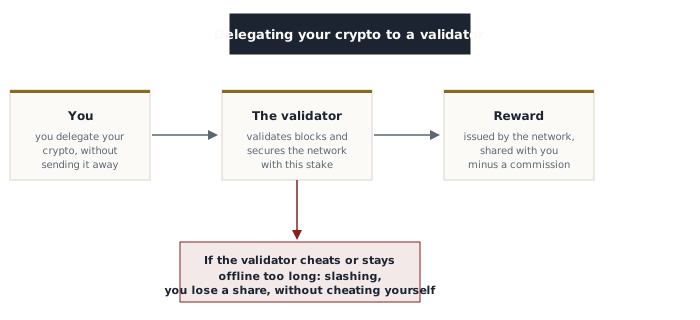
Running your own validator, the computer that directly takes part in validating blocks, takes both technical skill (a server that has to stay online at all times) and often a high minimum stake: on Ethereum, for instance, running your own validator requires 32 ETH, an amount well out of reach for most individual holders.
The vast majority of people therefore take part differently, by delegating their cryptocurrency to an already-running validator managed by someone else, with no infrastructure to manage themselves. The validator then redistributes a share of the rewards it receives to everyone who delegated funds to it, usually after taking a commission for its own work.
Slashing, the risk specific to staking
A deterrence mechanism called slashing punishes a validator that misbehaves, for example by validating two conflicting versions of the same block, or by staying offline too long: part of the staked amount is then permanently confiscated by the protocol. The important thing to understand for someone delegating rather than running their own validator: this slashing risk applies proportionally to everyone who delegated to that validator, even if they themselves did nothing wrong. Choosing who to delegate to therefore isn't a minor detail: a validator with a history of outages or poor technical setup directly exposes its delegators to this risk, with no control at all over the cause.
Lock-up periods, the money you can't withdraw right away
Once cryptocurrency is staked, it generally stays locked for an unbonding period, which varies by blockchain, from a few days to several weeks, during which it's impossible to withdraw or sell it, even if its price drops sharply over that stretch. This is a real liquidity risk, separate from price risk itself: staked money isn't instantly available like a plain wallet balance, contrary to what many newcomers assume before committing to it.
Liquid staking, an answer to the liquidity problem
Some protocols offer a solution to this lock-up: liquid staking. In exchange for the staked cryptocurrency, the user receives a representative token, freely tradable or usable elsewhere in decentralized finance, while the original funds keep generating rewards in the background. This solves the liquidity problem, but adds an extra layer of trust: trust in the liquid staking protocol's own smart contract, which becomes a new surface of risk, exactly the kind of dependency worth checking before trusting a project that's too recent or has no independent audit (see the article on crypto scams).
Real return versus promised return: where the line sits
Staking's real return comes directly from the rate at which the protocol itself issues new cryptocurrency, a publicly verifiable figure, not a marketing promise. That rate generally drops as more participants stake on the same network, since the same amount of rewards ends up shared among more people. This is an essential difference from the guaranteed-return scheme described in the article on crypto scams: legitimate staking pays a modest, variable percentage, directly tied to a mechanism verifiable on the blockchain itself. Any platform offering "staking" with a fixed return noticeably higher than the network's real rate isn't, in the overwhelming majority of cases, doing real staking at all: it's simply borrowing the word to dress up a Ponzi scheme with a veneer of technical legitimacy.
Good habits before staking
- Independently check the network's real reward rate, rather than relying solely on the figure a platform displays
- Understand the unbonding period's length before committing funds, especially an amount you might need to get back quickly
- Choose a validator with a genuine track record of reliability if delegating, rather than the one simply advertising the lowest commission
- Be highly suspicious of any fixed, high staking return disconnected from the underlying network's real rate
At its core, staking remains a legitimate mechanism, publicly documented on the blockchain itself. It's exactly that transparency that makes it possible to spot, unambiguously, when someone else is just borrowing its name.