Crypto transaction fees (gas fees), why they swing so much
Listen to the audio version
Sending a cryptocurrency rarely costs the same price twice in a row, sometimes for the exact same kind of operation. This variation often surprises a beginner, even though it follows a precise logic, directly tied to how a blockchain processes transactions.
Why a transaction is never free
The article on blockchain explained that validators or miners process transactions and group them into blocks. That work takes time, computation, or a financial stake depending on the mechanism used, and nobody would do it for free at scale. Transaction fees directly pay for that work: they give validators an incentive to include one specific transaction in the next block, rather than another.
"Gas," the unit that measures the work requested
On Ethereum and blockchains that share its model, every operation consumes an amount of "gas," a unit that measures the complexity of the requested computation rather than a direct amount of money. A simple cryptocurrency transfer consumes little gas. A more complex smart-contract interaction, like a trade on a decentralized finance platform or minting an NFT (see the dedicated article), consumes noticeably more, since it requires more computational steps from the network to execute. A transaction's final cost is the amount of gas consumed, multiplied by the price of gas at that exact moment.
Why the price swings so much over time
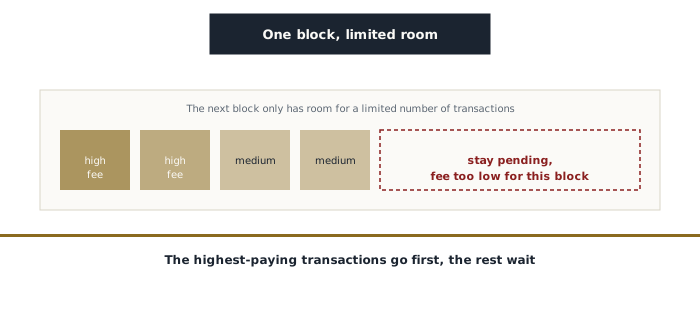
Every block can only hold a limited number of transactions. When demand outstrips that capacity, a mechanism close to an auction kicks in: transactions offering the highest gas price get processed first, the rest wait for the next block, or the one after, until demand drops or their offered price becomes competitive. This mechanism explains why fees spike sharply during a moment of heavy network traffic, for example a highly anticipated NFT collection launch or a period of high market volatility, and drop back down once that traffic subsides.
Why some blockchains cost far less than others
Faced with this limited-capacity problem, several blockchains have developed so-called "layer 2" solutions: a secondary network that bundles a large number of transactions together, then submits only a condensed, verifiable summary to the main blockchain, rather than each transaction individually. The cost of that single submission is then spread across every transaction in the batch, considerably lowering the individual cost of each one, while still relying on the main blockchain's security as the final guarantee. This is the main reason some blockchains or associated networks show noticeably lower fees than Ethereum directly, without sacrificing the security of the underlying mechanism.
The trap of a transaction stuck with fees set too low
Offering too low a gas price during a period of heavy traffic doesn't make a transaction fail immediately: it simply sits waiting, sometimes for several hours, until demand drops enough for it to become competitive, or sometimes indefinitely if congestion persists. Most wallets today suggest a realistic gas price by default, greatly reducing this risk, but manually lowering it without fully understanding the consequences remains a common source of frustration for beginners who think they've lost their transaction when it's simply still pending.
Good habits to keep
- Check the network's congestion level before a non-urgent transaction, to take advantage of a calmer, cheaper moment
- Never confuse a pending transaction with a lost one: it usually goes through eventually, or can often be replaced with a new offer at a higher fee depending on the wallet used
- Consider a layer 2 solution for frequent or small-value transactions, when the blockchain being used offers one
Transaction fees aren't an arbitrary cost imposed by a company, but a direct reflection of limited processing capacity shared by everyone at once. Understanding this mechanism helps you pick a good moment to transact, rather than being at the mercy of a price that seems to change for no apparent reason.