Bitcoin, stablecoin, altcoin: the differences that actually matter
Listen to the audio version
After understanding what a cryptocurrency is and how a blockchain works, one question often lingers: why do thousands of them exist, and what actually tells them apart?
Bitcoin, the historical benchmark
Bitcoin was designed as a decentralized currency, with a total supply fixed in advance and never adjustable: 21 million units at most, not one more. This limit is enforced by a built-in mechanism called the halving: roughly every four years, the reward paid to miners for each new block (see the article on blockchain) is cut in half, gradually slowing the creation of new bitcoins as it approaches the fixed limit, without ever exceeding it. This programmed scarcity, combined with its age and recognition, makes it the most established cryptocurrency, often used as the benchmark for the rest of the market.
Coin or token: why thousands of cryptocurrencies exist
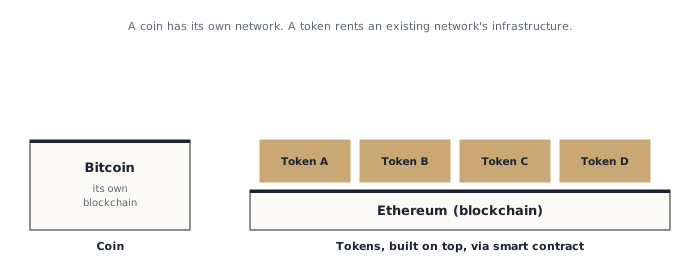
A common confusion comes from the fact that creating a new cryptocurrency doesn't always mean creating an entire new network. There are actually two different things at play. A coin (Bitcoin, Ethereum) has its own blockchain, built and maintained from scratch. A token, on the other hand, has no network of its own: it's created through a smart contract (see the article on blockchain) deployed on an already-existing blockchain, most often Ethereum, which lends its infrastructure and security to thousands of different tokens at the same time.
This difference explains why cryptocurrencies have multiplied: creating a token technically takes a few lines of code deployed on an existing network, while creating a real coin with its own blockchain takes considerably more work. A serious project can choose either option depending on its needs; a not-so-serious project almost always picks the faster route.
The stablecoin, a category of its own
A stablecoin is a cryptocurrency whose value is designed to stay stable, usually by being pegged to a traditional currency like the dollar. Its main purpose isn't speculation, but serving as a safe haven inside the crypto world: moving value around, or waiting for a better moment, without having to go back through a traditional currency each time.
How a stablecoin holds its value, and why that isn't always true
Three different methods let a stablecoin maintain its value, with very different risk levels. The most common method, known as fiat-backed, relies on real reserves held by the issuing company: every unit issued is supposed to correspond to a real dollar set aside, a promise whose reliability depends entirely on that company's transparency and audits. A crypto-backed method works differently: it's secured by other cryptocurrencies held in reserve, deliberately in a greater quantity than the value issued, to absorb a possible drop in their own value.
The algorithmic method, the riskiest of the three, rests on no real reserve at all: an algorithm tries to keep the price stable by automatically adjusting the available supply, with no safety net in case of a sudden, massive loss of confidence. This type of stablecoin suffered a spectacular failure in 2022, with the collapse of TerraUSD, which lost nearly all its value within days despite its promise of stability, taking several billion dollars down with it. That example remains a good reason to check how a stablecoin is actually backed before trusting it, rather than assuming the word "stable" is enough on its own.
What to remember to find your way around
- Bitcoin: the historical benchmark, designed as a decentralized store of value, with programmed scarcity
- Coin or token: a coin has its own blockchain, a token is built on top of an existing one, which explains why so many projects exist
- Stablecoin: designed for stability rather than growth, but with a risk level that depends entirely on how that stability is actually backed
Understanding these distinctions avoids the most common beginner mistake: treating every cryptocurrency as one and the same product, when they actually serve very different needs and risk levels.