CBDCs, central banks' digital currency
Listen to the audio version
The article on Bitcoin, stablecoins, and altcoins already distinguished several families of cryptocurrency. A CBDC (central bank digital currency) belongs to none of these families: strictly speaking, it isn't even a cryptocurrency.
What a CBDC actually is
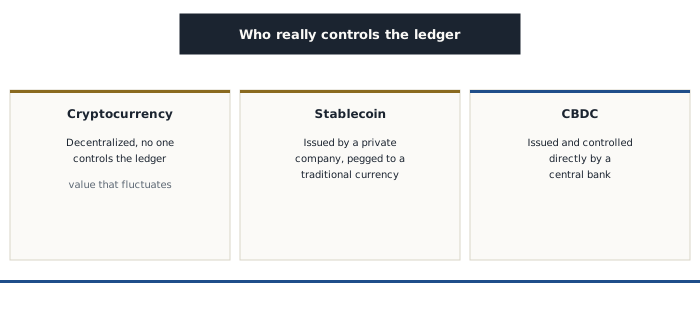
A CBDC is a digital version of a country's official currency, issued and controlled directly by its central bank, the same institution that already issues physical banknotes and coins. It isn't a new currency or a parallel one: it's the same existing national currency, in an official digital form rather than a physical one.
How it differs from a cryptocurrency
A cryptocurrency like Bitcoin relies, by design, on the absence of any central authority: nobody controls the ledger, spread across thousands of independent computers (see the article on blockchain). A CBDC does exactly the opposite: the central bank fully controls issuance and, depending on the case, the transaction ledger itself, which usually isn't a public ledger open to everyone the way Bitcoin's is, but a closed system managed directly by the issuing institution.
How it differs from a stablecoin
A stablecoin, already described in the article on Bitcoin and altcoins, is issued by a private company that promises to keep its value pegged to a traditional currency, a promise whose reliability depends entirely on that company's soundness and transparency. A CBDC needs no such promise: it is, by definition, the official currency itself, a direct claim on the central bank, not a private version trying to imitate it.
The two main approaches: bank-to-bank, or for everyone
CBDC projects fall into two broad categories. A wholesale CBDC stays reserved for exchanges between banks and financial institutions, invisible to the general public, who keep using their regular bank account as usual. A retail CBDC, rarer and far more debated, would be directly accessible to individuals, somewhat like an account opened directly with the central bank rather than an ordinary commercial bank.
What it changes for privacy
Unlike physical cash, inherently anonymous once in circulation, a retail CBDC could technically let a central bank observe every transaction made by every citizen, a level of visibility into individual financial habits that no physical currency allows today. This is the most debated point around CBDC projects worldwide: some projects explicitly build privacy protections into their design, others stay considerably less transparent on this exact point, which feeds a legitimate concern rather than a purely theoretical fear.
Where the world stands today
Several countries have already launched or tested a CBDC to varying degrees, with China's digital yuan among the most advanced and most studied projects, Nigeria with the eNaira, while the European Central Bank is actively studying a digital euro without having deployed it at scale yet. The situation is moving fast from one country to the next, a good reason to check the actual state of a specific project rather than assume it's set in stone.
Understanding the difference between a CBDC, a stablecoin, and a decentralized cryptocurrency helps avoid confusing three fundamentally different logics, which share only the appearance of digital money without sharing a single underlying operating principle.