What a wallet actually is, and how not to lose your crypto
Listen to the audio version
As soon as someone holds cryptocurrency, a question comes up fast: where is it actually stored? The answer often comes as a first surprise.
A wallet doesn't hold your crypto
Contrary to what the word "wallet" suggests, a wallet doesn't actually store your cryptocurrency inside it, the way a physical wallet would. Your cryptocurrency exists only on the blockchain (see the dedicated article to understand this mechanism). What your wallet actually holds are cryptographic keys, which prove you're the owner and let you act on what the shared ledger assigns to you.
Public key, private key: receiving and spending
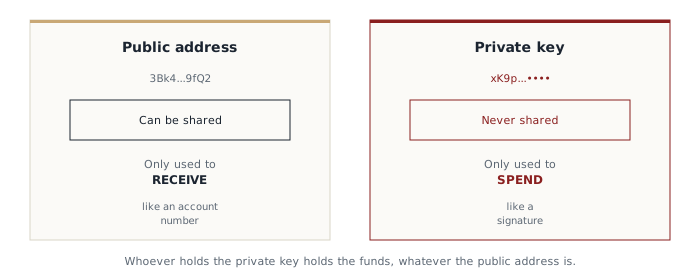
A wallet actually works with two complementary pieces. The public address (derived from a public key) works like an account number: it can be shared with anyone without risk, since it only allows receiving funds, never sending them. The private key, on the other hand, works like a signature: it's what authorizes spending, and it alone. Receiving cryptocurrency, then, requires nothing secret; sending it, or even simply having the power to, depends entirely on the associated private key.
This is what makes the saying "whoever holds the private key holds the funds" so central: it doesn't matter who's technically entitled to it, the private key alone decides who can spend.
A wallet at an exchange or a personal wallet: a real difference
Buying cryptocurrency on an exchange and leaving it there means never actually holding the private key yourself: the platform keeps it, a bit like a bank holds money deposited into an account. This is called a custodial wallet. It's convenient, but it also means the platform could, in theory, freeze access, go bankrupt, or get hacked, as has already happened to several major platforms in the past, with users' funds lost in the process.
A personal wallet, called non-custodial, flips this logic around: the private key exists only with its owner, never with a third party. This is where the well-known crypto saying comes from, "not your keys, not your coins": as long as the private key belongs to someone else, real ownership stays, in practice, in their hands.
The two main families of personal wallets
- The software wallet (an app on a phone or computer, or a browser extension): convenient for regular use, but the private key stays exposed on a device connected to the internet
- The hardware wallet (a small, dedicated physical device, often called a "hardware wallet"): the private key never leaves the device, even during a transaction, which makes it considerably more resistant to a remote hack
For small amounts used regularly, a software wallet remains reasonable. For an amount you really don't want to lose, a hardware wallet is strongly recommended.
The recovery phrase, the most critical piece
When a personal wallet is created, a phrase of 12 or 24 words is shown once: the recovery phrase (often called a "seed phrase"). It can rebuild full access to the wallet, keys included, on any device, including if the original device is lost or broken.
- Never store it digitally: no screenshot, no file, no email, no online password manager
- Write it down on paper, by hand, and keep it somewhere safe, ideally in two different places
- Never share it with anyone, including someone presenting themselves as technical support: no legitimate service ever asks for it
Whoever obtains this phrase obtains the private key it can rebuild, and can therefore empty the wallet entirely, with no way to reverse it and no recourse.
Why there's no one to call
For a personal wallet, with no bank or central institution, no service exists that can reset lost access or reverse a fraudulent transaction. This absence of an intermediary, which is the system's strength, is also what makes every mistake permanent.
Choosing a wallet carefully, understanding the difference between entrusting it to a third party or keeping it yourself, and protecting your recovery phrase aren't just precautions among others: they're literally what determines whether your cryptocurrency stays accessible or disappears for good.