Multisig: when a single key is no longer enough to approve a transaction
Listen to the audio version
The article on wallets described a simple but radical principle: whoever holds the private key fully controls the funds, with no recourse if that single key is lost or stolen. Multisig (short for "multi-signature") changes that balance of power by spreading it across several distinct keys instead of just one.
The principle: several keys, a threshold to reach
A multisig wallet is configured with a total number of keys and a minimum signature threshold required to approve a transaction, a configuration written as "M of N". A 2-of-3 wallet, for example, generates three distinct private keys, spread across three different devices or people, and requires two of those three keys to sign the same transaction before the network accepts it. The third key can be lost, or simply absent at the moment of spending, without blocking anything.
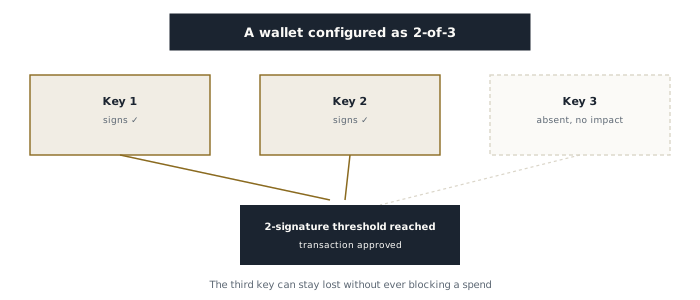
This multiple signature relies on the same cryptographic mechanism as a standard transaction signature (see the article on symmetric and asymmetric encryption): each private key produces its own independent signature, and the network verifies that enough valid signatures accompany the transaction before processing it. None of the keys ever needs to be shared with the others, nor even needs to know their exact existence for the system to work.
Why spread the power instead of concentrating it
A single-key wallet puts the entire security of the funds on one single point of failure: losing that key, having it stolen, or simply protecting it poorly is enough to lose everything for good. Multisig moves that risk from one single point to several points, each individually becoming less critical.
Concretely, this covers several quite different situations:
- A single person spreading their own keys across several physically separate devices (a computer, a hardware wallet, a bank vault), so that no isolated theft or failure is enough to lose everything, or to spend it all without their consent
- A couple or a family managing shared funds, where no spending can happen without the agreement of at least two designated people
- A company or an association managing a collective treasury, particularly a DAO (see the dedicated article), where multisig literally replaces a single executive's signature with an actual vote among several designated signers
What multisig protects, and what it doesn't
Multisig effectively protects against the theft of a single key: an attacker who compromises one device, for example through the kind of social engineering already documented in the Coldcard breach, only obtains one key among several, not enough alone to approve anything. It also protects against isolated human error: a malformed transaction or an unauthorized spend needs the agreement of a second, independent signer before it goes through.
It does not, however, protect against collusion between enough key holders to reach the required threshold, nor against a poor geographic or human spread of the keys that would empty the setup of its real value: a 2-of-3 wallet whose three keys physically sit in the same room, or in the hands of three people who systematically share their decisions with no real mutual check, offers little more than a single-key wallet.
The trade-off, in practice
The main drawback of multisig remains its operational complexity: every spend requires coordinating several signatures, which slows down a simple transaction and demands good organization among key holders, especially to avoid ending up unable to reach the required threshold if too many keys become unavailable at once. It's a deliberate trade-off between ease of use and resistance to the loss or theft of an isolated key, one that makes sense for large or shared funds, but is often excessive for everyday spending of small amounts.
Multisig doesn't replace good practices on each individual key; it adds an extra layer of resistance that becomes particularly useful the moment a single person, or a single device, should never again be enough to decide a spend alone.