The Coldcard hack, when a hardware wallet isn't as safe as it looks
Listen to the audio version
A hardware wallet is presented, including on this site, as the strongest protection against a remote hack: the private key never leaves the device, even during a transaction. A real incident revealed in early August 2026 shows, however, that a hardware wallet can be emptied without any hacker ever touching or coming near the physical device. Here's what happened, and why it doesn't overturn the basic advice, but sharpens it.
What happened
Coinkite, the maker of the Coldcard hardware wallet, published a security advisory on July 30, 2026, after a researcher at Block identified a flaw affecting how recovery phrases (seed phrases, see the article on wallets for what this phrase represents) were generated. Exploitation followed in four waves over four days: the first wave alone drained 594 bitcoins from around 500 different wallets in just 25 minutes. In total, the most complete estimates put the damage at around 1,816 bitcoins, roughly $116 million, spread across more than 5,200 affected addresses.
The flaw: a predictable key, not a remote hack
The problem didn't come from remote access to the device, which would have directly contradicted a hardware wallet's basic promise. It sat further upstream, in firmware version 4.0.1, released in March 2021: a configuration error caused the recovery phrase to be generated using a software random number generator instead of the chip's dedicated hardware generator, normally far more reliable at producing genuinely unpredictable randomness.
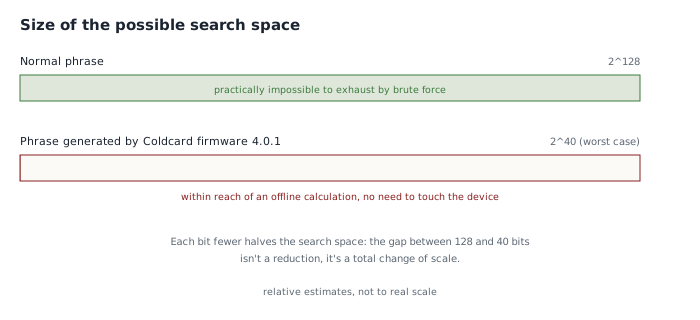
A standard recovery phrase rests on about 128 bits of randomness, a space of possibilities so vast it makes an exhaustive search completely impractical, even with considerable computing power. The flaw reduced that real randomness to a much smaller value, in some analyses barely 40 bits, a search space trillions of times smaller, well within reach of an offline brute-force calculation, with no need to ever touch the victim's device.
Why the key "that never leaves the device" wasn't enough
This is the most counterintuitive part of this incident: the hardware wallet's central promise, that the private key never leaves the device during a transaction, held up perfectly. No transaction leaked any information, no device was hacked remotely during use. The problem sat five years earlier, at the exact moment the key was created: a key generated predictably stays predictable forever, no matter how well it's protected afterward. An unbreakable safe is useless if the combination was drawn from a list of a thousand possibilities rather than ten billion.
The trap of an incomplete fix
One detail of Coinkite's response deserves particular attention, because it reaches well beyond this one incident. Updating the firmware fixes the flaw for any new phrase generated after the update, but does nothing at all to protect phrases already generated with the vulnerable version: those keys stay just as predictable as before, even on a freshly updated device. Coinkite therefore had to ask affected users not simply to update, but to migrate the entirety of their funds to an entirely new phrase, generated after the fix. One victim explained losing $1.6 million despite saying she'd followed the usual good security practices, a reminder that even genuine caution offers no protection against a flaw invisible from the very start.
What this actually changes
A hardware wallet remains, by a wide margin, the best protection available against remote theft, and this incident changes nothing about that conclusion: it isn't the category of tool that failed, but a specific error in a specific version of a specific firmware, invisible for five years before being discovered and exploited. The real lesson is more general: a hardware wallet's security depends as much on the quality of its code, verifiable only by a competent third party and by time, as on the fact that the key never leaves it. A device left without an update for a long time, or whose recovery phrase was generated by an old firmware version never since renewed, deserves a check, not trust granted once and for all at the time of purchase.