What a DAO actually is, when code replaces a company's leadership
Listen to the audio version
The article on blockchain introduced smart contracts as programs able to automatically enforce a rule, with no human intermediary. A DAO pushes that idea to its logical conclusion: what if an entire organization's governance rules were also written directly into a smart contract, instead of traditional legal bylaws?
What a DAO actually is
A DAO (decentralized autonomous organization) is an organization whose operating and decision-making rules are defined by a smart contract published on a blockchain, rather than by a leadership team, a board of directors, or bylaws filed with a government body. Decisions aren't made by a handful of executives, but through a vote open to holders of a governance token specific to that DAO, generally weighted in proportion to how much each participant holds.
How decision-making power works
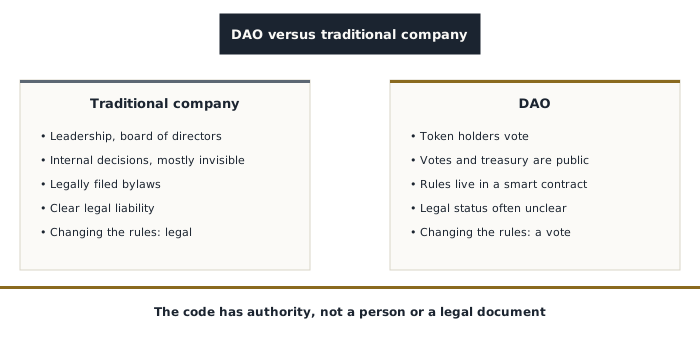
Any holder of governance tokens can generally propose a change, an expense, or a new direction, which then goes to a vote among all holders. The vote's outcome, and how it's actually carried out (often releasing an amount from the DAO's shared treasury), executes automatically according to the rules set in the smart contract, with no person needing to manually approve the decision once the vote concludes. Every vote and every treasury movement stays publicly visible on the blockchain, a level of transparency rarely reached in a traditional organization, where internal deliberations usually stay private.
The founding case: "The DAO" and the 2016 hack
The history of DAOs begins with a spectacular failure that has since become a textbook case. In 2016, a project simply called "The DAO" raised the equivalent of nearly $150 million in ether, a considerable sum at the time, aiming to run an investment fund entirely managed by its members through votes. A few weeks after launch, an attacker exploited a flaw in its smart contract (a reentrancy bug that allowed the withdrawal function to be called several times in a row before the balance was updated) to withdraw the equivalent of about $60 million before anyone could stop it.
Since "code is law" and no central authority could legally reverse the transaction, the Ethereum community found itself facing an impossible choice: accept the loss as final, or retroactively alter the blockchain's own history to undo the theft, an operation that directly contradicts the immutability principle already explained in the article on blockchain. The second option ultimately won out, but part of the community rejected that choice on principle and kept running the old version of the chain, without the fix: that exact disagreement is what gave rise to two separate blockchains, Ethereum and Ethereum Classic, both still active separately today.
Why "code is law" is both a DAO's strength and its limit
The DAO episode perfectly illustrates the trade-off at the heart of every DAO. The fact that no leadership team can unilaterally override a voted decision is presented as an advantage, a safeguard against corruption or the arbitrary whims of a handful of executives. But that same principle means a bug in the smart contract becomes, by construction, just as final and unchallengeable as a legitimate decision: nothing and no one can step in to fix a mistake mid-execution, unlike a traditional company where a decision can always be reversed or challenged by an identifiable human authority.
The legal gray area, a real thing to watch for
A DAO's legal status remains, even today, poorly defined in most jurisdictions around the world. Unlike a traditional company, whose legal liability is clearly assigned to an identified structure, each DAO member's liability in the event of a dispute or debt often stays ambiguous, a gray area very few countries have, to date, addressed with a specific law. Joining or investing in a DAO is worth considering with this legal uncertainty in mind, separate from the usual financial risk of the crypto world.
Real-world uses today
- Governing a decentralized finance protocol's parameters (rates, fees, new features), with token holders voting on technical changes
- Managing a shared treasury meant to fund projects, a bit like a collective investment fund
- Coordinating a community around a shared goal, artistic or charitable, with decisions made collectively rather than by a handful of organizers
Good habits before joining or investing in a DAO
- Check whether the DAO's smart contract has been audited by an independent security firm, exactly the same caution already recommended for any recent crypto project (see the article on crypto scams)
- Look at how governance tokens are actually distributed: a DAO where a handful of wallets hold most of the tokens is decentralized in name only, since those few holders can force through any decision they want
- Don't underestimate the real legal gray area around a member's personal liability, before committing any money
At its core, a DAO remains a simple, coherent idea: replacing trust in leaders with trust in public, verifiable code. The story of The DAO is simply a reminder that verifiable code is only useful if it's actually been thoroughly verified before entrusting it with a significant sum.