What a cryptocurrency actually is
Listen to the audio version
Cryptocurrency comes up everywhere, often with complicated words from the very first sentence. Before anything else, there's a simple problem to understand, and everything starts there.
The problem digital money had to solve
A physical bill can only be handed over once: once it's in someone else's pocket, it's no longer in yours. A digital file, on the other hand, can be copied endlessly without losing any quality. This almost trivial-sounding detail is actually the biggest obstacle to creating purely digital money: technically, nothing stops you from copying a file representing money and spending it twice. This is called the double-spending problem, and for a long time it was only solved one way: a central bank that keeps everyone's accounts and checks that a given amount is never spent twice.
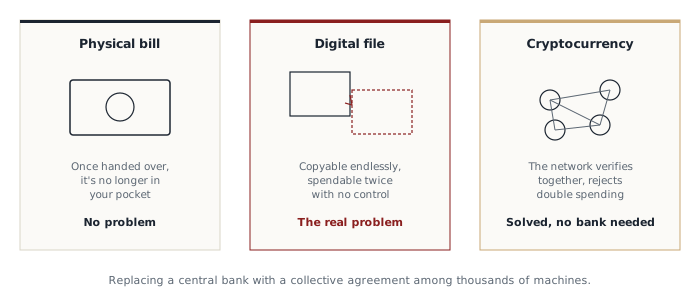
A cryptocurrency solves this same problem without a central bank. Instead, a very large number of computers spread across the world verify and record transactions together, according to rules fixed in advance, and collectively refuse any attempt to spend the same amount twice. Nobody needs to trust a single company or a single country: the system works because thousands of machines agree with each other on what actually happened (the exact mechanism behind this collective agreement, blockchain, gets its own separate article).
Where new cryptocurrency actually comes from
A question almost always comes up at this point: who decides to create new units, since there's no central bank to print money? The answer varies by cryptocurrency, but the most common principle is called mining: computers that dedicate their processing power to verifying and validating the network's transactions receive, as a reward for that work, freshly created new units. This mechanism is what replaces the central bank: creating currency becomes a reward for verification work, not an administrative decision.
Bitcoin, the first example
Bitcoin, created in 2009, was the first cryptocurrency to work at scale. Its original goal was precisely that: letting two people exchange value directly, with no bank, no border, and with no one able to unilaterally decide to create more currency at will beyond the rules set from the start.
Thousands of others exist today, sometimes with very different goals from one another. Bitcoin remains the historical benchmark, a bit like how the first search engine stays associated with the entire category that followed it.
Why the price swings so much
The value of a cryptocurrency like Bitcoin can swing by several percent in a single day, a level of volatility rare for a traditional currency. Two reasons explain this gap. First, the available supply is often fixed in advance and can't be adjusted to stabilize the price, unlike a traditional currency that a central bank can inject into or pull out of circulation. Second, the market remains, globally, still relatively small compared to traditional financial markets: a large purchase or sale therefore has a proportionally bigger effect on the price.
What this actually changes
- No one can freeze an account or reverse an already-validated transaction, unlike a bank
- Everyone is solely responsible for the security of their own cryptocurrency: there's no one to call in case of loss or theft (see the article on wallets to understand how to protect them properly)
- Transactions are publicly visible on the system's ledger, even though the identity behind each address isn't directly visible
What a cryptocurrency isn't
A cryptocurrency isn't automatically a profitable investment, nor a currency that's stable over time. Nor is it, despite a stubborn reputation, a tool reserved for illegal activity: above all, it's a value-transfer system that works differently from traditional money. Its legal status also varies a lot from one country to another, and keeps evolving, which is worth checking locally before any serious use.
One thing is worth remembering for everything that follows: a cryptocurrency replaces trust in an institution with trust in a shared system, capable of collectively solving a problem that a simple digital file couldn't solve on its own. Everything covered next (wallets, blockchain, scams to avoid) follows directly from this idea.