Blockchain explained simply
Listen to the audio version
"Blockchain" is probably the most used and least explained word in the world of cryptocurrency. Once stripped of jargon, though, the concept is easy to follow, and it answers a precise question: how can a network of computers that don't trust each other still agree on what actually happened (see the article on cryptocurrency to understand why this problem comes up in the first place).
A ledger shared by everyone
A blockchain is a ledger, a kind of giant account book, recording the complete history of every transaction ever made. The distinctive part is that this ledger isn't kept in a single place: thousands of identical copies exist at once, on computers scattered all over the world. When a new transaction happens, it's verified by this network, then added to every copy at the same time.
Why "chain of blocks"
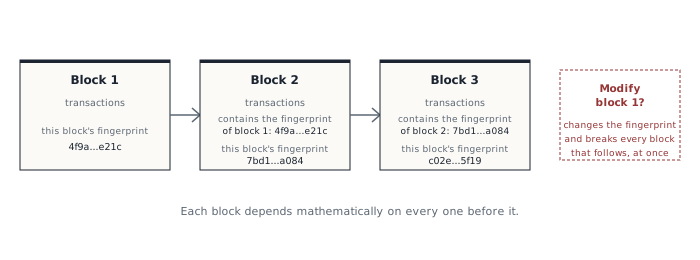
New transactions aren't added one by one, but grouped into batches called blocks. Each block contains, on top of its own transactions, a unique digital fingerprint of the previous block, a bit like a signature that depends entirely on its content. Modifying an old transaction would change its fingerprint, which would immediately break the link with the next block, and then with every block after it, on every copy in the network at once. It's this chain of dependencies that makes a silent modification practically impossible to slip through unnoticed.
How the network agrees without a central authority
One essential question remains: who gets to add the next block, and what stops everyone from proposing their own version at the same time? The historical method, used by Bitcoin, is called proof of work. The network's computers (the miners, see the article on cryptocurrency) enter into a kind of race: finding, through repeated trial and error, a specific number that, combined with the block's content, produces a fingerprint meeting a rule that's very hard to satisfy. This calculation takes an enormous number of attempts, and therefore power and energy, but once the solution is found, anyone can verify it instantly. It's this deliberate imbalance (hard to produce, easy to verify) that serves as the agreement mechanism: the first to find the solution proposes their block, and the rest of the network accepts it after verifying it in an instant.
Mining isn't the only method
Many recent blockchains, including Ethereum since 2022, no longer use proof of work, seen as too power-hungry at scale, but a different method called proof of stake. Instead of running powerful hardware, participants lock up a quantity of their own cryptocurrency, and are chosen to validate the next block roughly in proportion to what they've staked. A participant who tried to validate a fraudulent transaction would risk losing that staked amount, which replaces energy spending with direct financial risk as the deterrent mechanism.
Why nobody can easily cheat
In both methods, it's this combination that makes a blockchain hard to falsify: the data is duplicated thousands of times, and proposing a fraudulent version is expensive, whether in computing power or staked cryptocurrency. To quietly change a transaction, you'd need to convince or control the majority of this worldwide network at the same time, an operation whose cost far outweighs any possible benefit on the most widely used blockchains.
Beyond money: smart contracts
Some blockchains, Ethereum foremost among them, don't just record money transfers: they can also run small programs written directly onto the chain, called smart contracts. A smart contract automatically enforces a rule fixed in advance ("transfer this amount only if this condition is met") with no human involvement or intermediary, once published. This mechanism is what opened the door to uses well beyond simple currency, a topic broad enough to deserve its own article later.
What blockchain isn't
Blockchain isn't Bitcoin: Bitcoin is a cryptocurrency that uses a blockchain, but the mechanism is now used by thousands of other projects, sometimes with very different rules. Nor is it some magic technology capable of solving any problem: it answers one specific need, that of keeping a reliable, shared record without a central intermediary, nothing more and nothing less.
Once this mechanism clicks, most other concepts in the crypto world (wallets, transactions, scams to avoid) become considerably easier to place.