CPU and GPU, why a computer needs both
Listen to the audio version
A modern computer almost always contains two different types of processors, the CPU and the GPU, often presented as two versions of the same thing. In reality, they're built for almost opposite jobs, a difference that explains both why a video game runs better with a good graphics card and why artificial intelligence caused a worldwide shortage of those same cards.
The CPU, the generalist that does a bit of everything
The CPU (central processing unit) usually contains a small number of cores, anywhere from four to about twenty on a current consumer computer, but each one extremely versatile and fast at running complex, varied instructions, often in a logical order that depends on the result of the previous step. It's the CPU that runs the operating system, handles most software's general logic, and makes decisions that depend on one another, exactly the kind of work that doesn't easily split into thousands of small, identical pieces processed at once.
The GPU, thousands of simple cores working in parallel
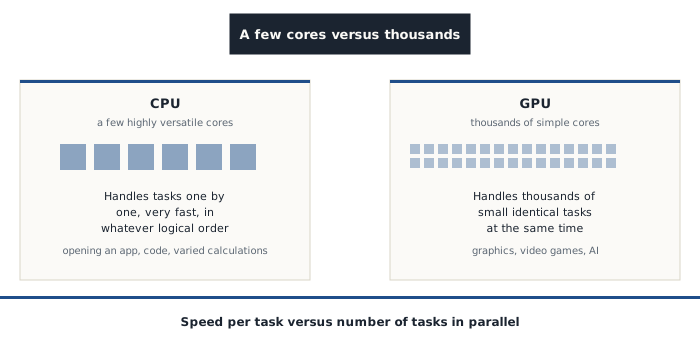
The GPU (graphics processing unit) follows the opposite logic: thousands of individually much simpler cores, but able to run the same operation on a huge amount of data at once. This design choice comes directly from its original mission, rendering graphics: calculating the color of each pixel in an image is a relatively simple operation, repeated millions of times per second, and above all completely independent from one pixel to the next. A GPU processes millions of these small, identical calculations in parallel, where a CPU would handle them one at a time, far more slowly for this specific kind of task despite its superior individual power per core.
Why artificial intelligence also needs the GPU
Training and running artificial intelligence models mainly rely on enormous numbers of matrix multiplications, a mathematical operation that can also be broken down into a multitude of simple calculations independent of one another. That's exactly the kind of work where a GPU's massively parallel architecture crushes a regular CPU's performance, which directly explains why the rise of artificial intelligence in recent years triggered considerable worldwide demand for these cards, to the point that their price and availability were affected for a long stretch, well beyond the video game market they were originally designed for.
Cryptocurrency mining, another parallel use
The article on Bitcoin mining describes a race to find, through repeated trial and error, a number that satisfies a specific condition. That task, also made up of millions of simple, independent attempts, naturally attracted the same graphics cards before specialized chips, built solely for that exact calculation (ASICs), took over for Bitcoin mining specifically, even more efficient than a general-purpose GPU for that one repetitive task.
What to keep in mind when choosing a computer
Everyday use (browsing, office work, most day-to-day software) mainly relies on the CPU, and a basic GPU, often built directly into the main chip rather than as a separate card, is more than enough. More demanding use (a recent video game, video editing, 3D modeling, or any local AI work) instead depends heavily on a dedicated GPU, a separate card with its own memory, considerably more powerful than a regular CPU's built-in version. Understanding this difference avoids the common mistake of only looking at CPU power when buying a computer, when the actual bottleneck, for a lot of modern uses, sits on the GPU side.