What's actually inside a data center, and why heat is the real problem
Listen to the audio version
The article on the cloud explained that a data center is a building filled with thousands of computers. What actually happens inside, and why these buildings have become one of the tech industry's biggest engineering challenges, deserves its own article.
The real challenge: getting rid of the heat
Thousands of servers running continuously give off considerable heat, to the point that cooling is often a data center's single heaviest energy expense, sometimes almost as large as powering the servers themselves. Most data centers use air-cooling systems, with carefully separated hot and cold aisles to optimize airflow, but the newest facilities, especially those built for artificial intelligence, are increasingly turning to liquid cooling applied directly to the chips, far more effective at removing heat concentrated on a small surface. Some operators even choose to build their facilities in naturally cold-climate regions, to mechanically reduce the need for active cooling.
Power supply, designed to never stop
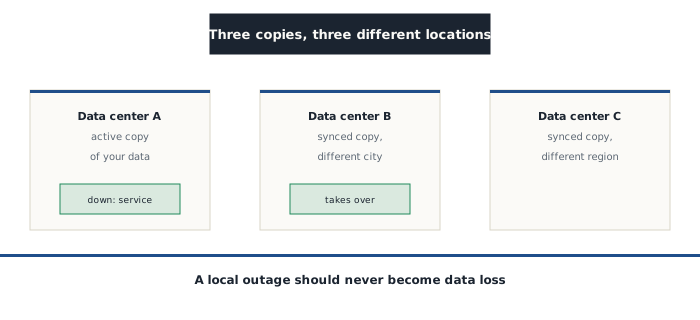
A serious data center never depends on a single source of electricity. A dual connection to the local power grid, backup batteries (UPS units) that take over in a fraction of a second during an outage, then diesel generators able to run for several days during a prolonged failure, form a redundancy chain designed so that no local outage ever turns into a service interruption customers can notice.
Reliability tiers, from Tier I to Tier IV
A classification system widely used across the industry, developed by the Uptime Institute, distinguishes four reliability tiers, from Tier I to Tier IV. A Tier I data center has basic infrastructure, with no particular redundancy: one component failing can interrupt service. Each tier above adds a further layer of redundancy, up to Tier IV, where every critical component (power, cooling, network) exists as an independent duplicate, allowing service to keep running even during maintenance work or the failure of an entire system. This is the classification demanding companies check before entrusting their services to a specific data center.
Physical security, even before IT security
A data center generally applies several layers of physical security before a visitor can reach a single machine: badge access followed by biometric verification, single-person access airlocks preventing someone from quietly following an authorized person through (see the article on social engineering for this specific risk, called tailgating), continuous video surveillance, and often zones whose access depends directly on the customer involved, with an employee only able to reach their own customers' machines, not the whole building.
Why artificial intelligence changed the scale of the problem
The article on the CPU and GPU explained that training AI models relies on GPUs that use far more power than a regular server. A server rack dedicated to AI therefore uses and gives off much more energy and heat, on the same floor space, than a traditional rack dedicated to more general-purpose tasks. This shift has driven a wave of new data centers built specifically for AI, with electricity needs so large in some regions that they now raise real concerns about whether local power grids can absorb this extra demand, an issue that echoes, at an entirely different scale, the one already covered regarding cryptocurrency mining's energy use (see the dedicated article).
A data center is therefore nothing like a simple room full of computers: it's a full-fledged piece of engineering infrastructure, where managing heat, electricity, and physical security matters just as much as raw computing power itself.