What the cloud actually is
Listen to the audio version
The word "cloud" conjures up an image of something floating somewhere, intangible. The reality is far more concrete, and far more down to earth.
What the cloud actually is
The cloud is simply a computer, or more often thousands of computers, installed in a building called a data center, reached remotely over the internet. When a photo is saved "in the cloud," it isn't floating in the air: it's physically stored on a hard drive, in a specific building, somewhere in the world, belonging to a company like Google, Amazon, or Microsoft.
The appeal is not needing to know exactly where that building is, or handling it yourself: the company takes care of maintenance, physical security, and uptime on the user's behalf, in exchange for a subscription or limited free use.
Three service tiers, without even knowing it
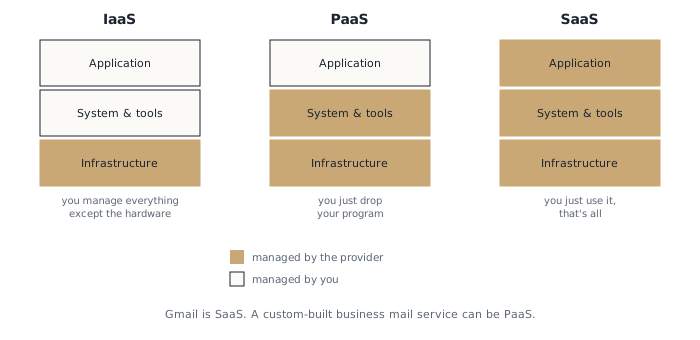
Not everyone uses the cloud the same way, even though the word stays the same. Three tiers exist, from the most technical to the simplest.
IaaS (infrastructure as a service) rents out a bare virtual machine, an empty remote computer on which a company installs its own system and software, as if it were buying a physical server without having to plug it in itself. PaaS (platform as a service) goes further: the provider also manages the underlying system and basic tools, and the company only has to drop its own program on top. SaaS (software as a service) is the tier everyone knows without naming it: a mail service like Gmail, a storage tool like a personal cloud drive, an app that's already entirely ready to use, where the user never has to worry about what's running underneath.
Why it's often more reliable than a hard drive at home
A personal hard drive that fails usually means losing its entire contents all at once. Major cloud services work differently: the same piece of data is almost always automatically duplicated across several drives, sometimes even across several different buildings, so that a single machine failing never makes anything disappear. It's this replication mechanism, not any kind of magic, that explains why losing data stored with a major cloud provider remains an extremely rare event compared to a personal hard drive failing.
Who can technically see your data
Storing data in the cloud means entrusting its safekeeping to a third-party company, and the question of who can technically access it is worth asking clearly. Most major providers encrypt stored data (so-called "at rest" encryption), but also hold the decryption key on their end so their own services can function (searching within files, previews, backups). This means unauthorized access to the provider's internal systems, or a court order, could in theory grant access to the actual content.
A minority of services offer end-to-end encryption, where the key only ever exists on the user's device, the same principle already covered for a good password manager (see the dedicated article): in that specific case, not even the provider can technically read the content. This is an important difference to know before choosing where to store something genuinely sensitive.
Why server location matters
A data center may be virtual in how it's used, but it's still physically located in a specific country, subject to that country's laws on data access and protection. This is why major providers often offer several regions to choose from: data stored on a geographically closer server also loads faster, since physical distance has a real, if small, effect on response time.
What this actually changes day to day
- Data becomes reachable from any device connected to the internet, not just the one it was created on
- A failure or breakage of the personal device doesn't make the data disappear, since a copy exists elsewhere
- Companies no longer need to buy and maintain their own physical servers to run a site: they rent computing power on demand, and only pay for what they actually use, an economic shift just as significant as the technical one
The simple thing to remember: the cloud is someone else's computers, somewhere, reached over the internet. Nothing more mysterious than that behind the word, but enough nuance behind the surface to know who, and at what level, you're really entrusting your data to.