What a CDN is, and why a site loads faster from some countries than others
Listen to the audio version
The article on data centers described a single building hosting a service's servers. A CDN (content delivery network) addresses a direct limit of that model: a single building, however well equipped, stays physically far from a good share of a site's visitors around the world.
The principle: bringing the content closer to the visitor
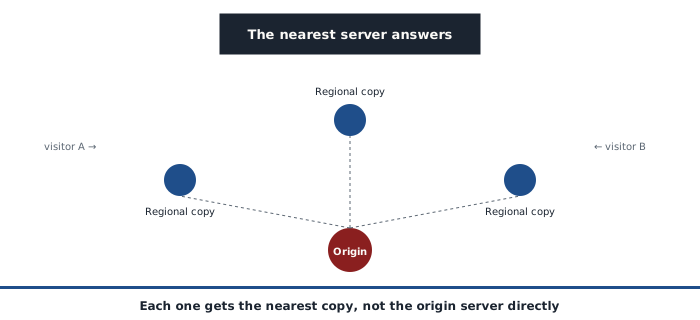
A CDN keeps copies of a site's content, especially its static elements (images, stylesheets, scripts, videos), on a large number of servers spread out geographically around the world. When a visitor loads a page, they receive that copy from the network point closest to them geographically, rather than reaching the origin server directly, which might sit thousands of kilometers away.
Why physical distance still matters
Even at the speed data travels across the internet, close to the speed of light, physical distance still adds a real, measurable delay: latency. A visitor on the opposite side of the world from a site's origin server feels that gap directly, a page that noticeably takes longer to start rendering, even if the origin server itself works perfectly. A CDN concretely shrinks that distance by answering from a network point that's much closer.
What a CDN also protects against: overload
Spreading traffic across many servers instead of relying on a single origin point has a second effect, this time on the security side: a sudden surge of traffic, legitimate or malicious, gets spread across the CDN's whole network rather than hitting the origin server directly. This is one of the reasons a CDN commonly also serves as a first line of defense against denial-of-service attacks, which specifically try to overwhelm a server with more requests than it can handle alone.
Caching, and why a page can seem to lag behind
Since a CDN serves an already-stored copy rather than content generated in real time by the origin server, an update to that content doesn't appear everywhere on the network instantly. Most CDNs refresh their copies automatically after a set delay, or allow that refresh to be forced manually (a cache purge) at the moment of an important change. This mechanism explains why a change just published on a site can occasionally seem not to apply right away, until that copy updates across the whole network.
Understanding this mechanism helps explain why the perceived performance of the same site can vary so much from one country to another, a detail rarely tied to the quality of the hosting itself, but far more often to whether a properly configured CDN sits between that server and its most distant visitors.