Fiber, 4G, 5G: the differences between internet connections
Listen to the audio version
Fiber, 4G, 5G, DSL, satellite: these words come up constantly in carrier ads, without always being explained. They actually describe very different ways of getting the internet to a device.
DSL, the legacy technology
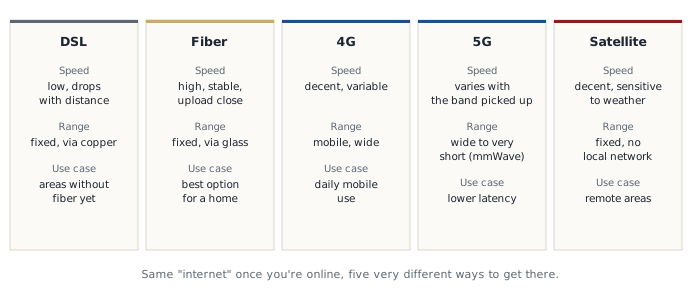
DSL runs the internet over the same copper phone lines already used for landline calls. It's an old technology, largely replaced today, but still present in some areas where fiber hasn't been installed yet. Its main limit: speed drops sharply with distance between the home and the nearest phone exchange, because the electrical signal gradually weakens as it travels through the copper cable.
Fiber optic, why light changes everything
Fiber carries data as pulses of light, through an extremely thin glass cable, rather than an electrical signal in copper. Light holds its intensity over a far greater distance than an electrical signal, which loses energy with every meter it travels through a copper cable. It's this physical difference, not just a marketing claim, that explains why fiber keeps a high, stable speed even far from the connection point, where DSL collapses after a few hundred meters.
4G and 5G, the mobile networks
Unlike DSL and fiber, which need a cable running to the home, 4G and 5G transmit the internet over radio waves, picked up directly by the phone from cell towers spread across the territory. This is what makes it possible to have internet away from home, while out and about.
5G isn't one single thing
A common source of confusion is that 5G doesn't use a single frequency, but three very different categories, often lumped together under the same name in marketing. Low-band covers a wide area, comparable to 4G, with a modest speed gain. Mid-band, the most common in actual use, offers the best trade-off between range and speed, and is what most users mean day to day when they say "5G." High-band (sometimes called mmWave) reaches extremely high speeds, but over a very short range, barely a few hundred meters, and gets blocked by a simple wall or even rain. This is why "5G" can feel barely faster than 4G in one spot, and dramatically faster a few streets away: it isn't the same band being picked up.
Beyond speed, 5G also improves latency, the response time between a request and its answer, which matters more for online gaming or video calls than top speed itself.
Download and upload speed: an asymmetry often forgotten
Most plans advertise a single speed figure, which is actually the download speed, almost always faster than the upload speed. This asymmetry is especially pronounced on DSL, where upload speed can be ten times lower than download speed, a detail that goes unnoticed watching a video, but becomes very noticeable the moment you send a large file or need a stable video call. Fiber sharply narrows this gap, with upload and download speeds often close to each other, a real advantage beyond raw speed alone.
Satellite, an alternative for poorly covered areas
Where neither fiber nor a good mobile network is available, a satellite connection (like Starlink) becomes a real option: a small terminal pointed at the sky talks directly to a constellation of low-orbit satellites, without depending on a local ground network. Speed stays below a good fiber connection, and the link can temporarily degrade in bad weather, but it delivers decent internet access in rural or remote areas where no other good wired or mobile option exists, a situation still common across parts of the African continent.
Why the advertised speed is almost never reached in practice
The maximum speed a carrier advertises corresponds to ideal conditions, rarely met day to day: how many users are connected at once on the same tower or in the same neighborhood, distance to the tower or exchange, the quality of a home's internal wiring for fiber. This is why two homes with the same plan can end up with fairly different real-world speeds.
Placing your own connection
- A fixed connection (fiber, DSL, or satellite) serves an entire home, shared across every connected device
- A mobile connection (4G, 5G) serves one device at a time, unlimited depending on the plan, but depends heavily on local network coverage and which band is picked up
These differences explain why a home well-equipped with fiber often keeps a more stable connection than a shared 4G connection, even when the advertised 4G speed looks comparable on paper.