Nextcloud, or how to become your own cloud provider
Listen to the audio version
The article on the cloud put it simply: the cloud is someone else's computers, somewhere. Nextcloud, free and open-source software, offers a different option: installing that same kind of service on a server you own or rent yourself, rather than handing that role to Google, Microsoft, or Amazon.
What Nextcloud actually does
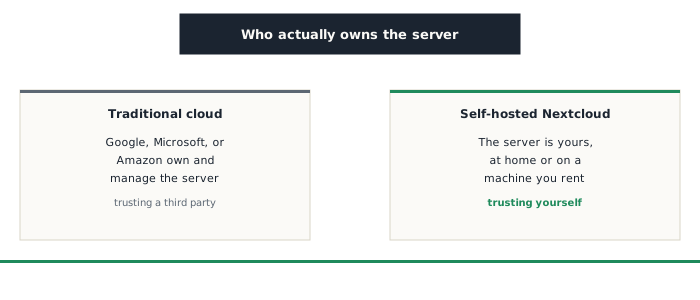
Nextcloud reproduces most of a regular cloud service's functions (file storage and sync, calendar, contacts, collaborative document editing) but runs the whole thing on a server chosen and managed by its own user, whether that's a physical machine at home or a server rented from a host. Since the code is open source, anyone can also independently verify what the software actually does with the data it handles.
What really changes: who owns the server
The essential difference isn't in the features, which stay very close to a regular cloud service, but in the question already raised in the article on the cloud: who can technically access the stored data. With a regular cloud service, that question depends entirely on the chosen provider's policy and security. With self-hosted Nextcloud, it comes down to a single answer: nobody but the server's owner, provided that server is itself properly secured and kept up to date (see the article on updates, especially relevant here since the responsibility for the server's security now rests entirely on its owner, not a dedicated team at a large provider).
The real cost of self-hosting: responsibility, not just money
Choosing self-hosted Nextcloud saves the monthly subscription of a major cloud service, but also shifts onto you every responsibility that provider would normally handle: keeping the server up to date, securing it properly, monitoring that it's running correctly, and above all organizing your own backups (see the dedicated article), since a personal server no longer benefits from the automatic replication across multiple data centers already described in the article on the cloud. A poorly maintained server can, in practice, turn out less reliable than a major professional cloud service, despite the full control it otherwise offers.
Who it's for
Nextcloud suits anyone who wants to put into practice the same principle already seen with Bitwarden or VeraCrypt: keeping full control rather than shifting trust onto a third party, even a reputedly serious one. It's a choice that demands a minimum of technical skill and regular upkeep time, not a universal alternative to a regular cloud for someone mainly looking for simplicity without ongoing attention.