Syncthing, syncing files without ever going through a server
Listen to the audio version
Nextcloud offered to become your own cloud provider, by hosting your own server. Syncthing, free and open-source software, pushes that logic even further: it removes the server from the equation entirely, even a personal one.
The principle: a direct connection between devices
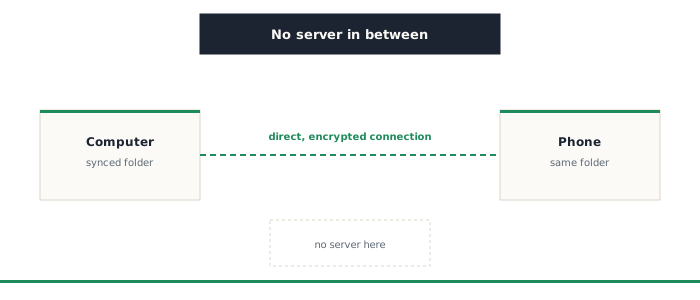
Syncthing syncs a chosen folder across several devices by establishing a direct, end-to-end encrypted connection between them, known as peer-to-peer. No central server, neither a company's nor even a personal one like with Nextcloud, takes part in the transfer: files pass directly from one device to another, or through a temporary encrypted relay only if a direct connection turns out to be impossible at that moment, with no copy ever durably stored anywhere but on the devices themselves.
What this changes compared to a cloud, even a self-hosted one
With Nextcloud, the personal server remains a single point to secure, maintain, and back up, a responsibility already detailed in the dedicated article. With Syncthing, that responsibility nearly disappears entirely: there's nothing to administer on an ongoing basis, no server exposed to the internet to protect. The direct trade-off is that two devices can only sync a file if at least one of them is on and reachable at the right moment: with no server always running, nothing can act as a permanent go-between for two devices that are simultaneously turned off.
Who it's for
Syncthing suits anyone who wants to sync files across several of their own devices, personal and work computer, phone, without ever entrusting a single copy to a third party, not even a personal server to maintain. It's the most radical option, among the software already featured on this site, when it comes to full control, at the cost of syncing that depends directly on the devices involved being available at the same time, rather than on an always-on server.