Bitcoin mining, why it uses so much energy
Listen to the audio version
The mechanism behind proof of work, the computational race that lets the Bitcoin network agree without a central authority, is already detailed in the article on blockchain. What's still missing is what that mechanism actually implies: who really mines today, with what hardware, and why the resulting energy bill is as high as it's often said to be.
Difficulty adjusts itself
The Bitcoin network targets a new block roughly every ten minutes, no faster and no slower, no matter how many computers are mining at any given moment. To hold that target as the network's total computing power keeps changing (it has, overall, only ever gone up since 2009), the protocol automatically recalculates the difficulty of the puzzle to solve every 2016 blocks, roughly every two weeks. If blocks were found faster than expected over that period, difficulty goes up; if they were found more slowly, it goes down. Nobody decides this adjustment: it follows mechanically from the time actually observed, built directly into the rules every node on the network applies the same way.
It's this mechanism, not anyone's decision, that explains why mining has grown more demanding over the years: the more computing power devoted to the network, the higher difficulty climbs to compensate, in a loop that never stops.
Why mining solo isn't realistic anymore
In Bitcoin's earliest days, mining with a simple personal computer's processor was enough to find blocks now and then. That era ended long ago. The network's current difficulty demands so much computing power that hardware has had to evolve accordingly: from consumer processors to graphics cards, then to chips custom-built for that one calculation, called ASICs (application-specific integrated circuits). A mining ASIC can't do anything besides that one exact calculation, but it does it with an efficiency neither a processor nor a graphics card can come close to matching.
This race for efficiency has a direct effect on who can still mine profitably. An individual with a single device, however powerful, now represents such a tiny share of the network's total power that the odds of finding a block alone, and therefore earning the corresponding reward, become close to zero over any reasonable timeframe.
Mining pools, and a question of concentration
Faced with this problem, most miners join a mining pool: several participants pool their computing power together, and the reward from a block the pool finds is redistributed among them in proportion to how much power each actually contributed, measured through a system of shares submitted regularly. A participant earns smaller but steady payouts this way, rather than a rare, unpredictable payout from mining alone.
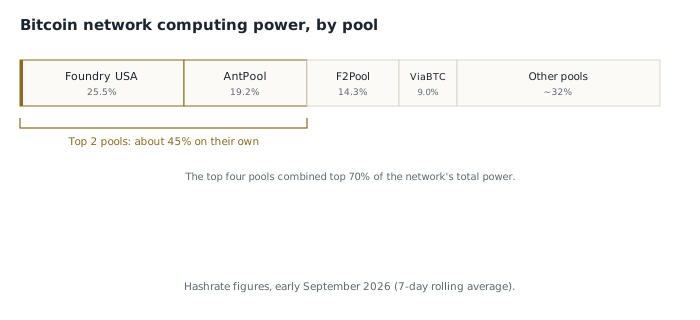
This pooling, however, raises a real question for a system meant to be decentralized: as of early September 2026, the two largest pools (Foundry USA and AntPool) alone accounted for about 45% of the network's total power, and the top four pools combined topped 70%. A pool doesn't directly control the funds of the miners who join it, but concentration this strong among a few players remains something the technical community watches closely, part of the reason some major pools adopted a new protocol in 2026 (Stratum V2), designed in part to give individual miners more control over how blocks are built, rather than leaving it entirely in the pool operator's hands.
Energy consumption, in real numbers
The Bitcoin network consumed, according to the most recent estimates from the Cambridge Centre for Alternative Finance (an independent academic reference on the subject), about 138 terawatt-hours over the past year, roughly 0.5% of global electricity consumption. This figure isn't fixed: it varies with the price of bitcoin (which determines whether mining stays profitable), the cost of electricity in the regions where mining farms are set up, and the efficiency of the hardware in use.
This consumption isn't an accidental side effect of the system, but a direct, deliberate consequence of proof of work itself: it's precisely because the calculation is expensive to produce, in both electricity and hardware, that it's hard to falsify; a cheap proof of work would offer no security guarantee at all. It's also what has pushed part of the mining industry to actively seek out very low-cost electricity sources, sometimes surplus renewable energy that would otherwise go to waste, sometimes natural gas that would otherwise be flared off at isolated oil extraction sites, a use that remains debated rather than unanimously seen as a solution.
The halving adds further pressure
The halving mechanism, which cuts the reward paid per block in half roughly every four years (see the article on Bitcoin, stablecoins, and altcoins for details), mechanically reduces miners' revenue each time it happens, without difficulty or electricity costs dropping to match. This pressure in turn pushes toward more efficient hardware and larger mining operations, able to absorb that drop in profitability through economies of scale, one more factor behind the concentration trend seen in recent years.
Mining a bitcoin today, then, has little left in common with the image of someone leaving their computer running: it's become an industrial activity, dominated by a handful of major players, whose real energy cost is the direct consequence of a design choice made from the very start, not a flaw discovered afterward.