What an algorithm actually is, and why the word doesn't mean artificial intelligence
Listen to the audio version
"The algorithm" has become, in everyday language, an almost threatening word, often used as if it referred to some mysterious artificial intelligence deciding everything on a human's behalf. The reality of the word is much simpler, and far older than social media or artificial intelligence.
The simple definition: a sequence of steps to solve a problem
An algorithm is, quite concretely, a precise sequence of steps for solving a problem or carrying out a given task. A cooking recipe is, technically, an algorithm: an ordered series of steps, followed in a specific order, to reach a predictable result. A computer algorithm applies exactly the same principle, in the form of code, to a problem the computer needs to solve.
Examples everyone uses without realizing it
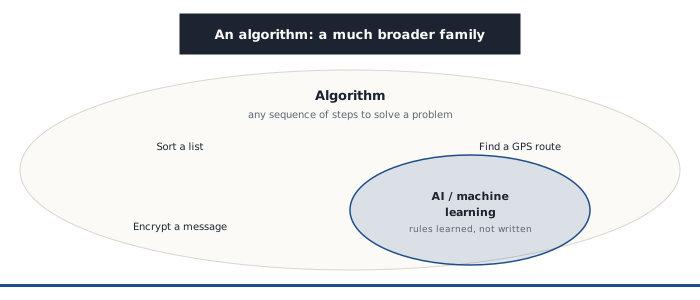
Sorting a list of names alphabetically follows an algorithm. Calculating the fastest route on a GPS map follows an algorithm. Encrypting a message (see the article on symmetric and asymmetric encryption) also follows a precise algorithm, a sequence of mathematical operations applied in a defined order. None of these examples has the slightest connection to artificial intelligence: they're rules written explicitly by a person, which always produce the same result for the same input.
Why "the social media algorithm" feels scary without anyone quite knowing why
The algorithm that decides how a news feed is ordered also applies a set of precise rules, generally weighted across several factors (the engagement a piece of content gets, how recent it is, closeness to the accounts someone follows). There's nothing magical or genuinely mysterious about the principle itself: the legitimate concern is mainly that these precise rules are rarely made public by the company that designs them, not the concept of an algorithm as such.
Where artificial intelligence changes things
The essential difference lies elsewhere. A classic algorithm applies rules written explicitly, in advance, by a person who understands every step of it. An artificial intelligence model, by contrast, doesn't follow hand-written rules: its "rules" are learned automatically from a large number of examples, during a phase called training, itself driven by learning algorithms. The end result is no longer a sequence of instructions a human wrote and can read back line by line, but a set of statistically adjusted parameters, often hard to explain precisely even for the people who built the training system.
Why this distinction actually matters
Understanding this difference helps place where certain concerns specific to artificial intelligence actually apply, such as bias inherited from training data, or the difficulty of precisely explaining an automated decision. These problems concern specifically the systems whose rules were learned rather than written, not the vast majority of everyday classic algorithms, which remain sequences of instructions that are perfectly predictable and verifiable by their own author.