What decentralized finance (DeFi) actually is
Listen to the audio version
The articles on staking and DAOs already mentioned decentralized finance in passing, without ever stopping on it. DeFi deserves its own explanation, though: it's the idea of applying the smart-contract principle, already covered in the article on blockchain, to entire financial services (lending, borrowing, trading) with no human intermediary at any step.
The principle: replacing a human intermediary with a contract
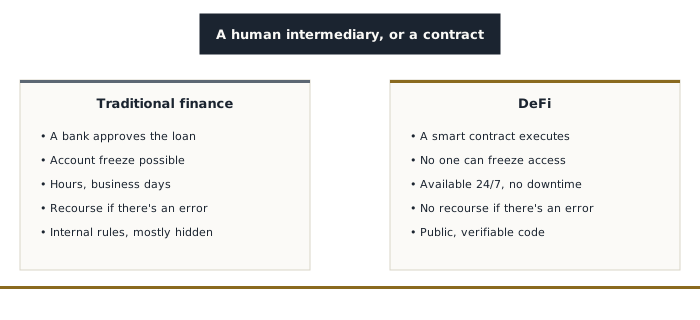
In traditional finance, a bank evaluates a loan request, approves or denies it according to its own internal criteria, and can freeze an account or reverse an operation if something goes wrong. In DeFi, that intermediary role is replaced by a smart contract: public code, whose rules are fixed in advance and visible to everyone, which automatically carries out an operation as soon as its conditions are met, with no person needing to approve it case by case.
Real-world uses
Lending protocols let you deposit one cryptocurrency as collateral to borrow another, with an interest rate automatically adjusted based on supply and demand on the protocol, rather than fixed by a bank's decision. Decentralized exchanges (DEXs) let you trade one cryptocurrency directly for another without going through a centralized platform that would hold the funds, relying instead on reserves supplied by other users rather than a traditional order book. Supplying funds to these reserves, a practice called providing liquidity, earns in return a share of the fees generated by trades, the same economic principle as staking, already described in the dedicated article, applied here to trading rather than securing a network.
Over-collateralized loans, a fundamental difference
A DeFi loan almost always requires depositing collateral worth more than the amount borrowed, sometimes 150% or more, an essential difference from a traditional bank loan. The reason lies in the complete absence of any identity check or credit history in a system where nobody actually knows who's behind a wallet address: with no legal recourse possible if an anonymous borrower defaults, the system protects itself solely through this excess collateral. If the collateral's value drops too close to the borrowed amount, the smart contract automatically liquidates it, selling it off to repay the loan, sometimes within minutes and without the slightest grace period a bank might grant in a comparable situation.
Risks specific to DeFi
- A bug in the smart contract stays irreversible once exploited, exactly as the article on DAOs showed with the 2016 hack of The DAO: no central authority can reverse a fraudulent transaction once the network has validated it
- Impermanent loss specifically affects those who provide liquidity to a cryptocurrency pair: if the prices of the two deposited assets move differently while they're sitting in the reserve, the value recovered when withdrawing those funds can end up lower than simply having held onto them untouched would have been worth, a loss often poorly understood by beginners who only look at the fees earned along the way
- Flash loans let you borrow a considerable sum with no collateral at all, provided you repay it in full within the same transaction, in a fraction of a second. This feature, legitimate on paper, has also been abused to artificially manipulate a protocol's displayed price for the length of a single transaction, before repaying the loan and walking away with a profit drawn from that manipulation, without ever putting up any capital of your own
What to check before using a protocol
- Whether one or more independent audits have been published, the same caution already recommended for any crypto project (see the article on crypto scams)
- The protocol's actual track record and age: a project active for several years with no major incident inspires more confidence than a very recent launch
- The total value locked on the protocol (TVL), a useful but not foolproof indicator on its own, since a high figure can also reflect recent hype rather than proven security
DeFi reproduces, with no human intermediary, a large part of what traditional finance already offers. Removing that intermediary eliminates certain friction points, but it also eliminates any recourse in case of an error or a flaw, a trade-off worth fully understanding before committing any amount you can't afford to lose.