Oracles, how a smart contract learns what happens off the blockchain
Listen to the audio version
The article on DeFi described smart contracts that lend, borrow, or swap automatically. None of those contracts can, on their own, know the real price of a cryptocurrency at a given moment: a blockchain is, by design, a closed system.
The problem an oracle solves
A smart contract (see the article on blockchain) only has direct access to what's already recorded on its own blockchain. Without outside help, it cannot check an asset's price on a market, the result of a sports match, or weather data, however useful that information might be to run its logic correctly. This lack of a native connection to the outside world has a name in the industry: the oracle problem.
How an oracle actually works
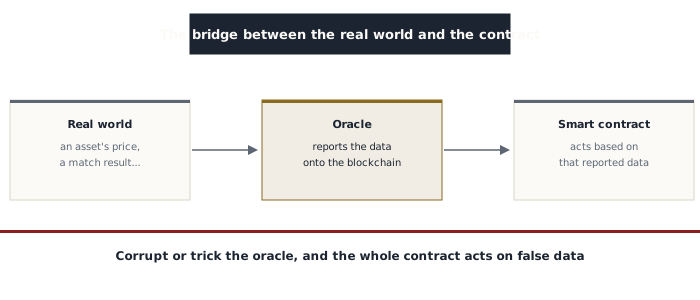
An oracle is a service that fetches a piece of real-world data, then publishes it onto the blockchain in a form the smart contract can read and use directly. This bridge is what lets a lending protocol, for instance, know at any moment the real value of a deposited collateral, information it needs to decide whether a position should be liquidated, exactly the mechanism already described in the article on DeFi.
Why relying on a single oracle is a point of weakness
A contract that trusts only one source for an outside piece of data inherits, directly, the reliability of that single source. If someone manages to manipulate or corrupt that source, even briefly, the contract then acts on false data as if it were true. This is exactly the flash loan exploit already described in the article on DeFi: artificially manipulating a displayed price for the length of a single transaction is enough, if the targeted contract depends on a single, manipulable oracle, to trick the whole system at once.
Decentralized oracles, the answer to this risk
Most serious projects address this risk by relying on a network of oracles rather than a single source: several independent data providers each report their own value, and the contract keeps a consolidated value, often a median, rather than trusting one isolated report. This principle repeats, on a smaller scale, the same logic already seen for the blockchain itself: spreading trust across several independent parties makes manipulation far more expensive and far less likely than targeting a single point of failure.
What this means for DeFi
A poorly designed or insufficiently decentralized oracle remains, to this day, one of the most common attack vectors in decentralized finance incidents: easier to manipulate than a bug directly in the contract's own code, and just as devastating once exploited. Before trusting a DeFi protocol, checking what kind of oracle its pricing logic relies on, a single source or a consolidated decentralized network, is a check just as relevant as the audit already recommended in the article on crypto scams.