Signal, the encrypted messenger whose protocol won over its own competitors
Listen to the audio version
Encryption is rarely judged on a company's own promise, but on its ability to convince other experts, even its own competitors, to adopt it. Signal, a nonprofit messenger, has pulled off something rare on that front: its own encryption protocol is now used by WhatsApp and Google Messages, two services far more widely used than Signal itself.
End-to-end encryption, what it precisely guarantees
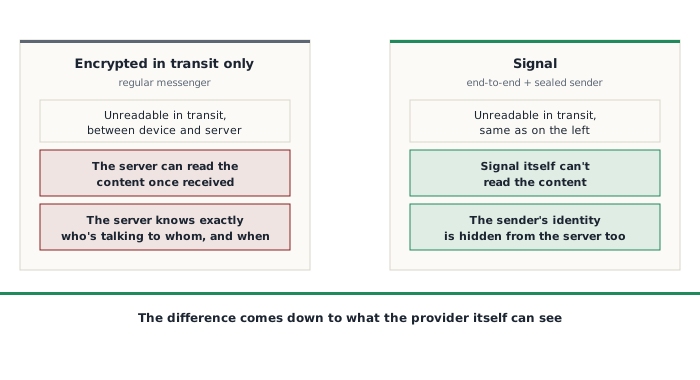
End-to-end encryption guarantees that a message can only be decrypted on the recipient's device, never in between, and not even by the company routing the message through its own servers. That's a fundamental difference from encryption that's merely "in transit," which only protects the network trip: the service provider then remains technically able to read the content once it reaches its servers, even if it promises not to.
The Signal protocol, now the benchmark beyond Signal itself
The Signal protocol relies on a mechanism called the double ratchet: each message uses an encryption key derived differently from the previous one, rather than a single fixed key reused for the whole conversation. In practice, even if a key were compromised at a given moment, it would decrypt neither the previous messages (thanks to what's called forward secrecy) nor the following ones once the conversation resumes normally (post-compromise security).
This protocol is open source, published and publicly documented, which has let other companies audit it independently and adopt it directly for their own services: WhatsApp has built it in since 2016, and Google Messages uses it to encrypt RCS conversations between compatible users. That's a stronger signal of technical trust than any marketing claim: two of the world's largest messaging services chose to rely on a protocol designed and published by an organization far smaller than themselves, rather than building a competing one in-house.
What even Signal can't see: sealed sender
Encrypting a message's content isn't enough to hide who's talking to whom, a piece of information called metadata, which alone can reveal a lot about someone's private life even without ever reading a single message. Signal has developed a feature called sealed sender, which hides a message's sender identity even from its own routing servers, revealing it only to the final recipient once the message is decrypted. Most messengers, including some that already encrypt content end-to-end, still know exactly who's exchanging messages with whom and how often, a piece of data Signal actively tries to minimize rather than simply accept as a given.
A nonprofit foundation, funded differently
Signal is developed by the Signal Foundation, a nonprofit organization initially funded by a loan of several tens of millions of dollars from Brian Acton, WhatsApp's cofounder, after he left Meta in 2018. This structure directly changes the business model: no ads, and no reselling data to third parties, unlike most free apps funded by monetizing their users' attention or information. The code, client and server alike, is published as open source, letting any independent researcher verify that the app really does what it claims.
Checking you're really talking to the right person: the safety number
Signal offers, for each conversation, a unique safety number generated from both participants' cryptographic keys. Comparing this number in person, or through a second trusted channel (a video call, for instance), verifies that no intermediary has inserted itself into the conversation to intercept it, an attack theoretically possible on any key-based system if the initial exchange channel isn't trustworthy. This kind of check is rarely used day to day, but it exists precisely for cases where a specific conversation's confidentiality genuinely matters.
Disappearing messages, and what they don't protect against
A conversation can be set to automatically erase every message after a chosen delay, from a few seconds to several weeks. This feature protects against long-term storage on the devices involved, but does nothing at all against a screenshot or a copy made by the recipient before the delay expires: nothing, in any messenger, technically stops someone from keeping a record of what they've read, an honest limit worth knowing rather than a false promise of total erasure.
The phone number, the historical limit, partly resolved
Signal long required a phone number to create an account, and automatically shared it with every contact in a conversation, a real inconvenience for anyone who'd rather not reveal that number. A username feature now lets you communicate without ever revealing your number to a contact, and the number itself can be removed once the account is created. The number is still required for the initial sign-up itself, though, a limit that hasn't fully disappeared, only shifted.
Things to keep in mind
- Signal protects the content and some of the metadata, but a device already compromised by malware (see the dedicated article) makes any encryption pointless, since the message is readable directly on screen before it's even encrypted
- The mere fact that someone has a Signal account remains, to some extent, information observable from outside, even if the content exchanged isn't
- As with any security tool, the promise is only as good as the vigilance of whoever uses it: keeping the app up to date remains essential (see the article on updates)
Who it's for
Signal is for anyone who wants a messenger whose technical guarantees have been independently verified, not just claimed, without radically changing their everyday habits. Its protocol's adoption by far larger services remains, to this day, one of the best pieces of evidence available that this trust isn't just deserved on paper.