Proton Mail, encrypted email, what it protects, and what Swiss law can still demand
Listen to the audio version
A regular email travels, in plain text or close to it, through several servers before reaching its destination, readable in theory at every step. Proton Mail, a Switzerland-based service founded by former CERN researchers, offers a different promise: the content stays unreadable even to the company itself. A real incident from 2021 shows precisely where that promise stops.
End-to-end encryption, between Proton inboxes
An email sent between two Proton Mail accounts is automatically end-to-end encrypted, with no manual setup and no key exchange to manage yourself, unlike the classic PGP encryption Proton is technically inspired by but whose complexity it hides entirely from the user. This encryption guarantees that neither Proton nor a network intermediary can read the message's content at any point along its path between the two accounts.
"Zero-access" encryption, even when the recipient isn't on Proton
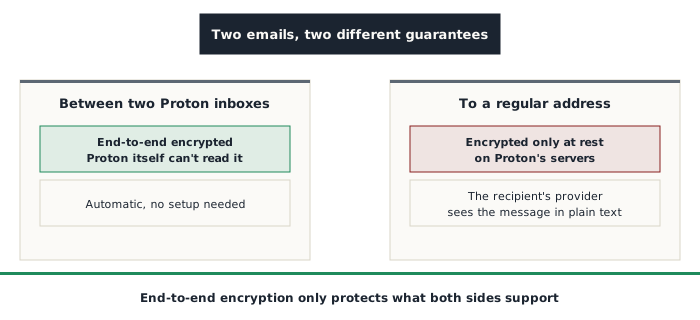
An email sent to an address that isn't on Proton follows a different path. Once stored on Proton's servers, including a message received from outside, it stays protected by what's called "zero-access" encryption: Proton itself doesn't hold the key needed to read it, since that key is derived from the account's password. This at-rest encryption, though, doesn't automatically extend to the trip toward an outside recipient: once the message is sent to a regular address, it becomes readable by the recipient's email provider, exactly like any unencrypted email. Proton offers a password-protected email option for this exact case, which encrypts the message even toward an outside address, provided the recipient knows the password, shared through a separate channel.
Based in Switzerland, and what that really changes
Switzerland has data protection legislation considered among the strictest in the world, and sits outside the direct legal reach of the European Union or the United States for most data requests. This is an argument Proton regularly highlights, rightly so in principle, but one worth qualifying with a real case rather than accepted as an absolute guarantee.
The 2021 incident: Swiss law can still apply
In 2021, French police forwarded, through Europol, a request to Swiss police concerning a Proton Mail account used by a collective of environmental activists. Switzerland's Federal Department of Justice issued a legally binding order requiring Proton to comply with that request. By default, Proton kept no IP address tied to its users' accounts, so there was literally nothing to hand over at the time of the request. The order nonetheless forced Proton to start logging the IP address and device fingerprint used for that specific account, from that point on. That data was later handed to authorities and contributed to arrests in France. Proton has since updated its privacy policy to explicitly spell this out: in the event of a violation of Swiss law, the company can be legally compelled to start logging the IP address of a specific account as part of a Swiss criminal investigation.
What this actually means for a user
This episode illustrates an important distinction, worth remembering beyond Proton's case alone: end-to-end encryption effectively protects a message's content, even against Proton itself, but doesn't automatically protect the anonymity of whoever uses the account. Proton collects no connection metadata by default, which makes a routine request practically useless, but a competent Swiss judicial authority can, within the appropriate legal framework, force the company to start collecting it for one specifically targeted account. It's the same principle already seen with Mullvad: trust shifts onto the provider and its legal framework, it never disappears entirely, whatever the country.
What Proton offers beyond email
Proton has expanded its offering into a set of services built on the same principles: Proton VPN, Proton Drive for encrypted file storage, Proton Calendar, and Proton Pass, a password manager. The whole suite is developed by the Proton Foundation, a nonprofit structure, with client apps published as open source, allowing the same independent verification already mentioned for Bitwarden.
Things to keep in mind
- The free tier stays limited in storage and features, a standard nudge toward the paid subscription, without being misleading about it
- Password-protected email to an outside address requires sharing that password through a separate channel, an extra step many skip in practice
- The 2021 incident remains the best concrete example available of what "based in Switzerland" actually guarantees, and what it doesn't
Who it's for
Proton Mail suits anyone who wants email whose content stays genuinely unreadable to the provider itself, without fundamentally changing their everyday habits. The 2021 incident, rather than discrediting the service, actually shows how well its default no-data-collection policy works as advertised: there was simply nothing to hand over, until a court explicitly required it for one specific case.