What an NFT actually is, and what it's really for
Listen to the audio version
An NFT sometimes sells for several thousand euros for what looks, on screen, like a plain image anyone could copy for free with a right-click. This apparent contradiction comes from a common misunderstanding about what an NFT actually owns.
NFT stands for "non-fungible token": what that really changes
An object is called fungible when every unit is interchangeable with another identical one: a €10 bill is worth exactly the same as another €10 bill, a bitcoin is worth exactly the same as another bitcoin (see the article on the differences between cryptocurrencies). A non-fungible object, by contrast, is unique and has no strictly interchangeable equivalent: a deed to a specific house, a numbered concert ticket, or an ID card are good examples in the physical world.
An NFT (non-fungible token) applies exactly this principle on a blockchain: it's a token, in the sense already explained in the article on Bitcoin and altcoins, deployed through a smart contract on an existing blockchain, most often Ethereum, but each copy carries a unique identifier and is interchangeable with no other, even within the same collection.
What an NFT actually owns, and what it doesn't
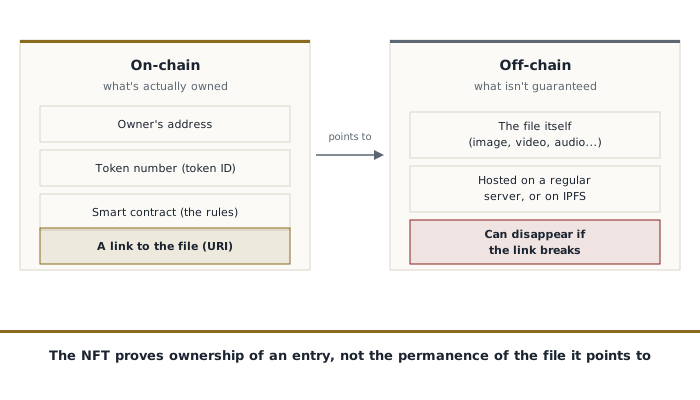
This is the most misunderstood part of the whole topic. A blockchain isn't built to store large files like a high-resolution image or a video: it would be far too expensive and far too slow at scale. What an NFT actually records on the blockchain is limited to a few lightweight pieces of information: the current owner's address, a unique token number, the rules set by the smart contract, and a link (a URI) pointing to where the actual file lives.
The file itself (the image, video, or audio) is therefore hosted elsewhere, off-chain, on a regular server or a decentralized system like IPFS. This distinction has a direct consequence: owning an NFT means owning the official record pointing to that file, not the file itself in any exclusive sense. A right-click can still copy the image, exactly as a reproduction of a work of art never replaces the original registered under its legitimate owner's name. This is also why an NFT whose file is hosted on a regular server, rather than a system built to last like IPFS, can technically lose its image one day, if that server shuts down or the link changes, with the blockchain itself keeping no corrective record of it.
The smart contract, what sets the token's rules
The smart contract tied to an NFT collection (see the article on blockchain to understand this mechanism) doesn't just record ownership: it can also encode automatic rules. The best known is the resale royalty, a percentage automatically paid to the original creator on every future resale of the NFT on the secondary market, with no manual step needed. That's a notable difference from traditional physical art, where the artist generally gets nothing from later resales of their work.
What it's actually used for, beyond profile pictures
The most talked-about use remains digital art and profile-picture collections, but the principle of a unique, verifiable token has broader uses:
- Ticketing: a concert or event ticket as an NFT makes each copy individually traceable, which makes counterfeiting harder and allows automatically capping or taxing resale
- Video game items: a game item held as an NFT genuinely belongs to the player rather than the game's publisher, and can in theory be transferred or resold outside the game itself
- Certificate of authenticity for a physical object: some luxury brands tie an NFT to a specific physical product to certify its origin and make resale on the secondhand market easier
- Access and membership: owning a specific NFT can serve as the key to a private community, exclusive content, or an event, without going through a traditional account system
Why the market exploded so much, then crashed
The NFT market grew extremely fast in 2021, driven by intense speculation more than any genuinely established use: many collections were bought with the sole goal of a quick resale at a higher price, with no connection to the token's actual utility. Once that speculative momentum ran out, most collections saw their resale value collapse, sometimes by more than 90%, leaving many late buyers holding a token that had become nearly unsellable. This doesn't call into question the NFT's technical principle itself, which remains a solid mechanism for verifiable ownership, but it's a good illustration of the difference between a technology and the speculative bubble that can form around it at a given moment.
Scams specific to NFTs
The mechanisms already described in the article on crypto scams apply directly here, with a few NFT-specific variants:
- The fake NFT airdrop (see the article on crypto scams) remains the most common technique: a token suddenly shows up in the wallet with no action taken, and interacting with it (viewing it on a fake site, trying to sell it) triggers a wallet-connection request leading to the approval-based theft already explained in that article
- A counterfeit NFT, a copy of an existing work minted without its original creator's consent on a contract different from the official one, can look visually identical to the original while having strictly no value or real connection to the artist
- Wash trading involves a creator, or an organized group, artificially buying and reselling their own NFTs between several wallets they control, to artificially inflate trading volume and the displayed price before drawing in real buyers
How to check an NFT is genuine before buying
- Check the collection's exact smart contract address, available on the project's official site, rather than relying solely on the name or image shown on a marketplace
- Compare that address to the one shown on the marketplace before any purchase: a counterfeit NFT almost always uses a contract different from the official one, even if its image is identical
- Be wary of any token that shows up in the wallet with no action taken, and never interact with it before checking its origin
- Never connect your wallet to an unverified site to "view" or "claim" an NFT received unexpectedly
At its core, an NFT remains a simple mechanism: a unique, verifiable token on a blockchain. What that mechanism actually represents (a speculative image, a ticket, a game item, or a certificate) depends entirely on the project using it, and it's that real utility, more than any advertised rarity, that should guide any purchase decision.