KYC, why a crypto platform asks for an ID
Listen to the audio version
Creating an account on a cryptocurrency exchange almost always requires providing an ID, sometimes a verification selfie. This step, called KYC, often surprises people in a world whose image stays tied to decentralization and anonymity.
What KYC means, and where it comes from
KYC stands for "Know Your Customer," a requirement stemming from anti-money-laundering and counter-terrorism-financing regulations, long imposed on traditional banks well before cryptocurrencies existed. Cryptocurrency exchanges that let you convert traditional currency into cryptocurrency, or the other way around, are treated, in most jurisdictions, as financial institutions subject to the same obligations.
Why it targets the exchange, not the wallet
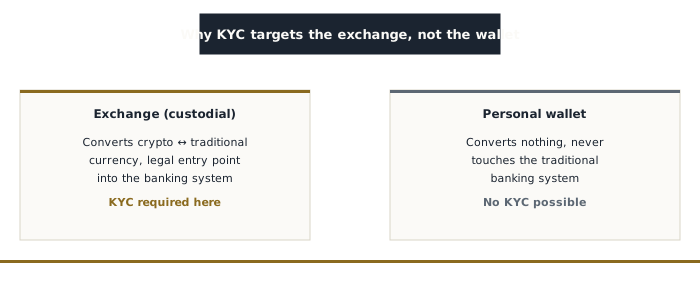
This requirement targets exactly the point where a cryptocurrency touches the traditional financial system, not the blockchain itself. The article on wallets already distinguished a custodial wallet, hosted by an exchange, from a personal, non-custodial one. A personal wallet never converts anything into traditional currency and never goes through a regulated financial institution: by nature, no KYC requirement exists at that level at all. It's the exchange, as the entry and exit point between the two worlds, that carries this legal obligation, not the protocol or the underlying blockchain.
What a platform actually does with this information
A standard KYC check compares the identity provided against international sanctions lists, keeps the documents for a period set by local regulation, and requires the platform to report to the relevant authorities any activity deemed suspicious under criteria defined by law, such as an unusual fund movement disproportionate to the account's profile.
The real trade-off: system-wide security versus individual privacy
KYC reduces certain risks at the scale of the global financial system, by making it harder to mass-create anonymous accounts used for money laundering or organized fraud. It also has a direct downside: it concentrates sensitive identity data at the exchange, which as a result becomes a particularly attractive target in the event of a hack, exactly the same concentration risk already seen with the DentaQuest breach or the Klue breach, applied here to identity documents rather than medical records or access tokens.
KYC-free platforms, and their real risks
Some platforms, often based in lightly regulated jurisdictions, offer trading with no identity verification at all. This choice avoids the privacy downside already mentioned, but usually comes with genuine legal uncertainty: in the event of a hack, bankruptcy, or an arbitrary freeze on funds, no clear regulatory framework protects the user, unlike a platform subject to recognized financial regulation. The choice between the two options comes down, once again, to weighing privacy against regulatory protection, rather than picking an option that's strictly better than the other in the abstract.
What to remember
KYC isn't some quirk specific to cryptocurrency, nor a targeted surveillance measure: it's the same regulatory boundary required to open a regular bank account, applied at the exact point where a cryptocurrency joins the traditional financial system. Understanding this boundary helps pinpoint exactly where this requirement stops, and why a personal wallet escapes it entirely, by design.