Layer 2s: how a blockchain escapes its own traffic jams
Listen to the audio version
The article on transaction fees explained why a transaction can cost a few cents one day and several dozen dollars the next: space in each block is limited, and when too many people want through at once, bidding goes up. "Layer 2s" are the main answer to that problem, and a large share of crypto transactions now go through them without their users necessarily knowing it.
Why not just make blocks bigger
The solution that comes to mind naturally would be to increase block size to fit more transactions in. The problem is that every participant who verifies the blockchain independently (a node, see the article on blockchain) has to download, check, and store every block. Bigger blocks make that verification heavier, and therefore reserved for fewer people, with more expensive hardware: the network gets faster, but also more centralized, which weakens precisely what makes it worthwhile.
This trade-off is often summed up as the blockchain trilemma: it's hard to get speed, security, and decentralization all at once. Layer 2s try to work around the trilemma rather than settle it.
The principle: work on the side, settle on the chain
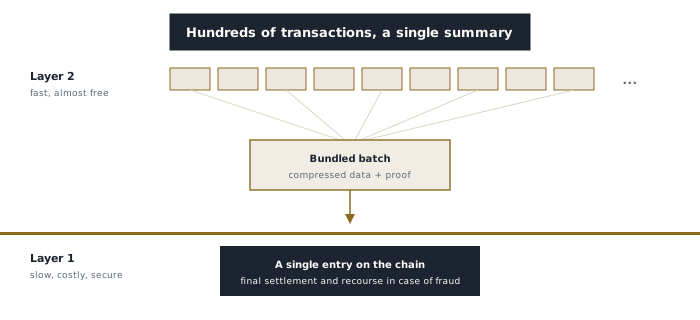
A layer 2 handles most transactions outside the main blockchain (called layer 1), then only writes a summary to it, or just the final result. The main blockchain no longer records every single payment one by one: it becomes a kind of court of last resort, guaranteeing that the final outcome is correct and that everyone can recover their funds in case of a dispute.
Lightning, Bitcoin's layer 2
The Lightning Network relies on payment channels. Two people lock bitcoins into a shared address that requires both their signatures, exactly the 2-of-2 multisig principle (see the article on multisig), with a single transaction on the blockchain. They can then send each other payments as many times as they like, instantly and almost for free, simply by updating between themselves how the shared balance is split, without writing anything to the blockchain. Only the channel's closing, with the final balance, gets recorded there.
The network becomes genuinely useful because channels link up with one another: to pay someone with whom there's no direct channel, the payment travels through a chain of intermediate channels, without any intermediary being able to seize it along the way. The trade-off: each channel needs enough funds on the right side to let the payment through, and software has to watch the blockchain to stop the other party from trying to close the channel with an older, more favorable balance.
Rollups, Ethereum's layer 2
On the Ethereum side, the dominant layer 2s are rollups: they bundle hundreds of transactions, execute them on their own, then publish the batch's compressed data on Ethereum, along with the means to prove the result is correct. Two families differ in how that proof works:
- Optimistic rollups (Arbitrum, Optimism, Base) treat each batch as valid by default, and leave a window during which anyone can challenge a fraudulent result by proving it. Direct consequence: withdrawing funds back to Ethereum often takes a week, the time for that challenge window to expire
- Zero-knowledge rollups (ZK rollups, such as zkSync or Starknet) attach a mathematical proof of validity to each batch, verified by Ethereum, which removes that waiting period at the cost of much heavier computation
Since an Ethereum upgrade in March 2024 created a cheaper space reserved for this data, fees on these rollups have often dropped to a few cents.
What you trust in return
A layer 2 adds parts to the machine, and each one is a place where things can go wrong:
- Bridges: moving funds from layer 1 to a layer 2 or another chain goes through a contract that holds the original funds in deposit, making it one of the most profitable targets in the whole ecosystem. The Ronin bridge lost around 620 million dollars in 2022, an attack attributed to the Lazarus group already encountered in the Drift Protocol hack, and the Wormhole bridge around 320 million the same year. The September 2026 theft on Liquid, a chain attached to Bitcoin (see the dedicated article), followed the same logic: creating bitcoins on the other side without having deposited anything in exchange
- The sequencer: on many rollups, a single entity, often the company that launched it, decides the order of transactions. It can't steal funds, but it can go down or delay certain transactions
- The exit delay: on an optimistic rollup, getting funds back to layer 1 is never instant without going through a third-party service that fronts the money, for a fee
- The label itself: "layer 2" is a marketing term applied to systems with very different guarantees, some inheriting only part of the main blockchain's security
Layer 2s don't make the blockchain faster: they move most of the activity elsewhere, keeping the main blockchain as a guarantee of last resort. Knowing which layer one's funds actually sit on, and through which bridge they got there, is part of the questions worth asking before depositing an amount that matters.