Bug bounties, when a company pays you to find its flaws before anyone else does
Listen to the audio version
The article on software updates explained that a flaw becomes dangerous at scale once it's made public with no fix available. A bug bounty starts from that same logic, but applies it upstream: paying someone to find the flaw before a malicious attacker does it instead.
The principle: pay for the discovery instead of suffering the exploit
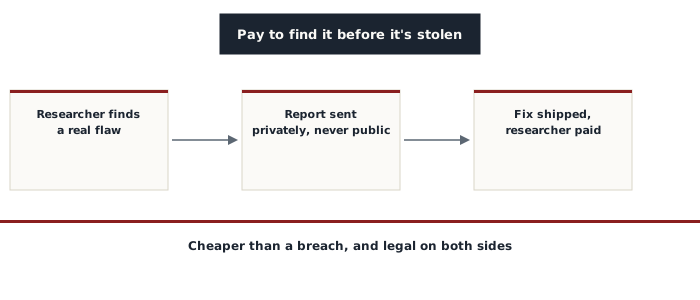
A bug bounty program invites independent security researchers to actively look for flaws in a site, app, or service, in exchange for a financial reward proportional to the severity of what they find. Instead of discovering a flaw once it's already being exploited against real users, the company pays to discover it first, in a setting it fully controls.
How a report actually plays out
A researcher who finds a flaw under a bug bounty program never makes it public right away. They send a private, detailed report to the company involved, often through a dedicated platform that centralizes this kind of program for many companies at once. The company confirms the flaw, develops a fix, and then, once that fix is deployed, the flaw can be made public or credited to the researcher, depending on the program's rules. This delay isn't a formality: making a flaw public before a fix exists would mean creating, on purpose, the exact window of maximum danger already described in the article on updates, handing potential attackers a head start over the company itself.
The reward range, very wide
The size of a reward depends directly on the severity of the flaw found: a minor issue, with no real consequence for a user, usually pays little, while a critical flaw allowing full access to sensitive data on a major platform can pay considerable sums, sometimes tens of thousands of dollars for the most serious cases at the largest tech companies.
Why it's cheaper than a breach
Even the highest reward in a bug bounty program remains, in the vast majority of cases, far lower than the real cost of an actual breach: crisis management, legally notifying the people affected, lost trust, sometimes regulatory penalties. The breaches already covered on this site, like DentaQuest's or Klue's, give a sense of the gap: paying a researcher a few thousand dollars for a flaw that was never exploited costs infinitely less than dealing with the real consequences of a large-scale breach.
A clear legal framework, both ways
Testing a system's security without authorization remains, in most countries, a criminal offense, regardless of the good faith of the person doing it. A bug bounty program solves this directly: it defines a precise scope of what can legally be tested, and what stays strictly off-limits, protecting the researcher from potential prosecution as long as they stay within that scope. It's this explicit legal framework that sets a bug bounty researcher apart from an ordinary hacker, even though the technical skill involved can be rigorously identical on both sides.
What this actually changes
Bug bounties offer a legal, paid outlet for skills that could otherwise end up used maliciously, a channel useful both to the company, which gains security, and to the researcher, who gains legitimate recognition and income. For a lot of people starting out in cybersecurity, taking part in this kind of program, often after training on CTF (capture the flag) competitions, remains one of the most concrete ways to put offensive skills into practice within an entirely legal framework.