What a database actually is, and why the word shows up in every breach
Listen to the audio version
Almost every news incident already covered on this site, from DentaQuest to Klue, mentions a compromised database, without ever pausing on what that word actually refers to.
A table, but one you can query
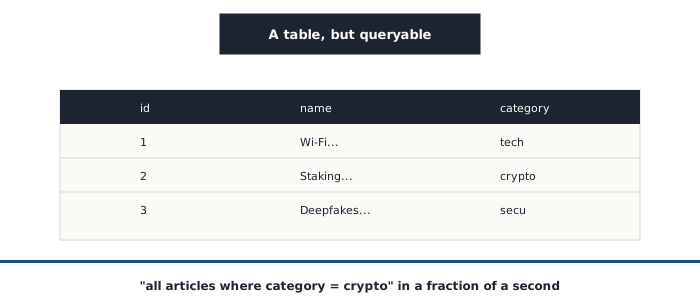
At its simplest, a database looks like a table: rows, columns, information organized in a structured way. What sets it apart from a plain file or a spreadsheet is the ability to query it directly, rather than having to scan through the whole thing every time to find a specific piece of information.
SQL, the way you ask a question
The vast majority of structured databases are driven by a standardized language, SQL, which lets you phrase a precise request ("give me every row where this condition is true") without needing to write a complex program to get it. This language stays, give or take a few variations, the same from one database system to another, which makes it one of the most transferable skills in programming.
Why a search is nearly instant even across millions of rows
A well-designed database maintains a side structure called an index, a bit like a book's index that tells you directly which page a specific word is on, without needing to read the entire book to find it. Without that index, looking up a specific piece of information would mean scanning every row one by one, far too slow an operation once the data volume passes a few thousand rows. It's this index structure that keeps a search nearly instant even across millions, or billions, of rows.
Relational and NoSQL databases: two different approaches
Relational databases, the oldest and most widespread kind, organize data into tables linked together by precise rules, with a structure fixed in advance. So-called NoSQL databases, more recent, loosen that structure to gain flexibility or the ability to handle massive volumes spread across many machines, at the cost of some guarantees that relational databases offer more naturally. The choice between the two depends on the problem being solved: neither approach is strictly better than the other in the abstract.
Why a poorly protected database is such an attractive target
A database concentrates, in a single place, every piece of information an organization holds on its users or customers. That concentration is exactly what makes it such an attractive target for an attacker: compromising a single, well-stocked database can yield millions of records in one go, where attacking each person individually would take a proportionally enormous effort. It's this concentration mechanism, more than any specific technical flaw, that explains the scale of breaches like DentaQuest's or Klue's, already covered on this site.
What this actually changes
That same logic is why a database at rest gets encrypted, why who can connect to it is strictly restricted, with credentials as well protected as a personal password (see the dedicated article), and why the information actually kept is limited to the strict necessary. A database that only holds what's genuinely useful is, by construction, less dangerous to lose than one that indefinitely piles up everything that might someday come in handy.