PhantomRaven: the AI-written malware that stole credentials to... find bugs worth reporting
Listen to the audio version
The article on bug bounty described a clear legal framework that protects a researcher as long as they stay within a program's authorized scope. A case revealed in September 2026 shows what it looks like when something borrows the appearance of bug bounty hunting while stepping entirely outside that framework.
What happened
PhantomRaven, a JavaScript-based piece of malware built to steal credentials, was distributed through more than 100 malicious packages published on npm, the main JavaScript package registry already mentioned in the article on the axios breach. First flagged in late 2025 by researchers at Koi Security and DCODX, the software specifically targeted authentication tokens and CI/CD secrets belonging to developers who installed those packages. The cybersecurity firm CrowdStrike has since attributed the operation to an actor active since November 2022, who publicly presents themselves as a bug bounty hunter having already collected rewards from at least nine organizations, across technology, retail, and hospitality.
A distribution technique built to dodge analysis
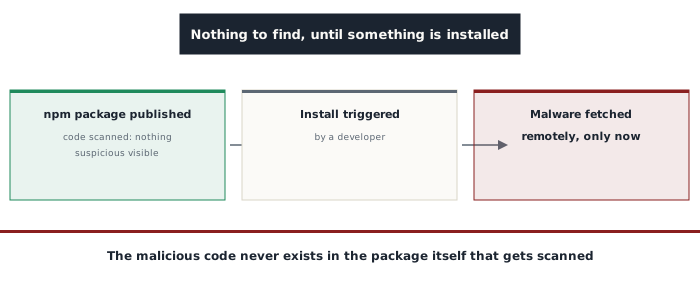
The malicious packages published on npm never directly contained the malware's own code: only at install time did they fetch a dependency retrieved remotely from an external server. This technique makes a classic static scan of the published code entirely useless, since there is literally nothing suspicious to find in the package until someone has actually installed it.
The most troubling detail: where the stolen data went
A typical credential-stealing piece of malware almost always feeds a black market where stolen credentials get resold between buyers. CrowdStrike found no trace of the data collected by PhantomRaven on that kind of market, an absence the firm considers telling: it believes the operator likely uses the stolen credentials solely to spot exploitable flaws at their victims, then reports them afterward through legitimate bug bounty programs, in exchange for a financial reward.
Why this blurs the line drawn in the article on bug bounty
The article on bug bounty explained that a program defines a precise scope, legal on both sides, within which a researcher can test with real legal protection. This case never fits that framework at any point: no matter how real or legitimately fixed the flaw eventually reported turns out to be, the method used to find it, distributing malware to developers who never consented to anything, remains an unauthorized intrusion, entirely outside the scope any legitimate program would define. Looking somewhat like bug bounty hunting from a distance isn't enough to actually respect its framework.
AI's role in the attribution itself
CrowdStrike attributes the malware's own code, with high confidence, to a large language model, based on unusually detailed comments in the code, placeholder code typical of automated generation, and a statistical analysis of the token patterns used. It's an unusual use of artificial intelligence on both sides at once: generating the malicious code on one hand, and on the other, relying on the statistical fingerprint left by that same generation to help attribute its origin, an interesting mirror of the distinction already drawn in the article on algorithms.
This case is one more reminder that a good final intention, fixing a real flaw, never makes whatever method was used to get there legitimate.