Tails, the operating system built to leave no trace at all
Listen to the audio version
The article on Tor Browser covered a browser that anonymizes web traffic. Tails goes further by anonymizing the entire computer: it's a full operating system, designed from the ground up to leave strictly no trace of its own use.
A system that boots from a USB stick, never installed
Tails (The Amnesic Incognito Live System) is a Linux-based operating system, distributed as an image to be written onto a USB stick or DVD. It's never installed on the hard drive of the computer used: on boot, the computer starts directly from the USB stick, and the entire system runs in RAM, never touching the internal hard drive or any other operating system that might already be installed on it.
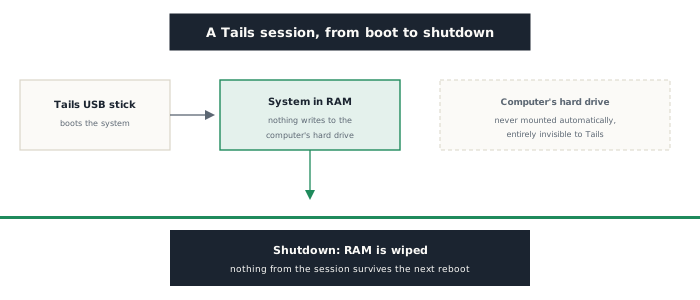
This choice has a direct consequence on the host machine's hard drive: it stays entirely invisible to Tails, which never mounts it automatically, and therefore can neither read from it nor write to it without an explicit action from the user. A public computer, a borrowed computer, or even one potentially compromised at a software level, can be used this way without Tails leaving the slightest trace on it, or inheriting whatever is already there.
Amnesic by design
The project's name contains the exact word that sums up its behavior: amnesic. When the computer shuts down, the RAM that held the entire running system is wiped, and with it everything that happened during the session: browsing history, temporary files, any passwords typed, open documents. None of it survives the next reboot, unless explicitly saved elsewhere.
This systematic amnesia eliminates a risk many classic security measures leave open: forgetting. A sensitive file deleted "by hand" on a regular hard drive often leaves recoverable traces (see the reverse logic covered in the article on VeraCrypt regarding disk encryption). With Tails, there's simply nothing left to remember to erase: the entire session disappears automatically, no action required.
Every connection forced through Tor
Tails doesn't just bundle Tor Browser: it forces the entire system's network traffic through the Tor network, regardless of which application is involved. An application attempting to connect directly to the internet, bypassing Tor, is simply blocked by the system itself. This radical choice eliminates a common source of error with a more typical use of Tor Browser alone, where another application on the same computer can, without anyone noticing, reveal the real IP address by connecting directly on the side.
Tails also systematically changes the MAC address of the network card used at every startup, a normally fixed unique hardware identifier, to prevent a given network from linking two different Tails sessions to the same physical device.
Persistent storage, the deliberate exception to amnesia
Total amnesia raises an obvious practical problem: no way to keep a single document, contact, or setting from one session to the next. Tails addresses this with optional persistent storage, an encrypted partition created on the same USB stick, in which specific folders can be configured to survive reboots: documents, messaging contacts, encryption keys, Wi-Fi configuration. This partition stays encrypted by default, and its very existence isn't revealed without the matching password, a principle close to the hidden volume already documented for VeraCrypt.
Who it genuinely makes sense for
Tails was designed for, and continues to be used in practice by, fairly specific profiles: journalists working with sensitive sources, people living under a regime that actively monitors or censors the internet, survivors of domestic abuse trying to avoid tracking by a partner with access to the household computer, or whistleblowers. For ordinary everyday use, the real speed penalty imposed by systematically routing through Tor, and the deliberate lack of persistence by default, make Tails noticeably less practical than a regular system.
What Tails does not protect against
- A computer whose firmware or BIOS is itself compromised could in theory observe what happens even before Tails starts
- Tails does not protect against someone physically watching the screen during the session
- Connection speed stays noticeably slower than direct browsing, because of the systematic routing through Tor
- Tails does not anonymize an account that's already personally identifiable, logging into one's usual email account through Tails reveals identity just as surely as without Tails
Tails remains a tool for specific circumstances rather than a daily-use system, built precisely for the moments when leaving absolutely no trace matters more than convenience.